Find affordable tradespeople

HaMuch is Excellent

Currently Viewing Posts in Plumber

10 Questions to Ask Before Hiring a Plumber

10 Questions to Ask Before Hiring a Plumber

Hiring a plumber often happens when something is already leaking, blocked or not working. That urgency can make it tempting to choose the first person who answers the phone, but a few clear questions

Hiring a plumber often happens when something is already leaking, blocked or not working. That urgency can make it tempting to choose the first person who answers the phone, but a few clear questions can save a lot of stress later.

The best questions to ask before hiring a plumber are not complicated. You are simply trying to find out whether they are qualified for the job, whether the price is clear, whether they are insured, and whether you will have proper backup if something goes wrong.

Before you start calling around, it is worth checking local plumber rates so you have a realistic price benchmark. A quote is much easier to judge when you can compare it with real, transparent pricing data by trade and location, rather than relying on guesswork or waiting until after you have sent off a job request.

Prices can also vary by area. A plumber in London may have different labour, travel and parking costs from one in Birmingham or Manchester, so local comparison matters.

Quick checklist of questions to ask a plumber

Question What it helps you check
Are you qualified for this exact job? Whether they have the right skills, especially for gas, heating or unvented cylinders
Are you insured? Whether your home and their work are protected if something goes wrong
Can you provide a written quote? Whether the price is clear before work starts
Is it a fixed price or an estimate? Whether the final bill could change
Have you done similar jobs locally? Whether they understand the type of property and plumbing issue
Who will actually do the work? Whether the person you speak to is the person attending
How will you diagnose the problem? Whether call-out charges and investigation time are clear
Which parts will you use? Whether materials are suitable, available and included in the price
Do you guarantee the work? Whether you have comeback if the same fault returns
What paperwork will I receive? Whether you will get invoices, certificates or landlord records where needed

1. Are you qualified for this exact type of plumbing work?

Not every plumber does every type of plumbing job. Some focus on leaks, taps, toilets and pipework. Others specialise in heating systems, boilers, bathrooms, drainage or commercial properties.

Ask the plumber whether they have experience with your specific issue. Replacing a kitchen tap is very different from tracing a hidden leak, installing an unvented hot water cylinder or working around a boiler.

If the work involves gas, such as a gas boiler, gas pipe, gas hob or gas fire, the person must be Gas Safe registered. You can check this through the official Gas Safe Register. Ask to see their Gas Safe ID card and make sure the categories on the card match the work being carried out.

For water supply and mains water work, you may also want to look for an approved plumber through schemes such as WaterSafe, especially if the job involves drinking water pipework or compliance with water regulations.

2. Are you insured, and can I see proof?

A reliable plumber should be able to tell you what insurance they carry. Public liability insurance is the main one homeowners usually ask about, as it can help cover accidental damage caused during the job.

If the plumber is bringing employees or subcontractors, it is also sensible to ask how those people are covered. You do not need to interrogate them, but a genuine professional should not be offended by a polite request for proof of insurance.

This matters for small jobs as well as big ones. A tiny leak behind a basin can damage flooring, kitchen units or a ceiling below. Insurance does not replace good workmanship, but it is an important safety net.

3. Can you give me a written, itemised quote?

A verbal price is easy to misunderstand. Before you agree to the work, ask for a written quote that sets out what is included.

A good plumbing quote should usually make clear whether the price includes labour, materials, VAT, call-out charges, waste removal, parking costs and any follow-up visit. For larger jobs, it should also break down the main stages of work, rather than giving one vague total.

This is where HaMuch can help you sense-check the figure. Many tradesperson comparison sites do not show useful pricing upfront, while HaMuch focuses on real, comparable local pricing data so you can compare quotes more confidently before you commit.

4. Is this a fixed price or an estimate?

A quote and an estimate are not the same thing. In plain English, a fixed quote is the agreed price for a defined piece of work. An estimate is the plumber's best judgement based on what they can see at the time.

Some plumbing jobs are hard to price exactly before investigation. For example, a leak under a floor may reveal damaged pipework, rotten boards or poor previous repairs once the area is opened up. That does not mean an estimate is bad, but the plumber should explain what might change the final cost.

Ask what happens if the job turns out to be more complicated than expected. A good plumber will pause, explain the issue, give you an updated price and ask for approval before carrying on with extra work.

5. Have you completed similar jobs recently?

Experience with similar jobs is often more useful than a general promise that they can handle it. Ask whether they have dealt with the same type of problem, property or system recently.

For example, older homes can have pipework that has been altered several times over the years. Flats may have awkward access, shared drainage or building management rules. Rental properties may need tidy communication with tenants and paperwork for the landlord.

Customer reviews are useful here, especially when they mention the same type of work. Look for comments about punctuality, communication, tidiness and whether the price matched the quote.

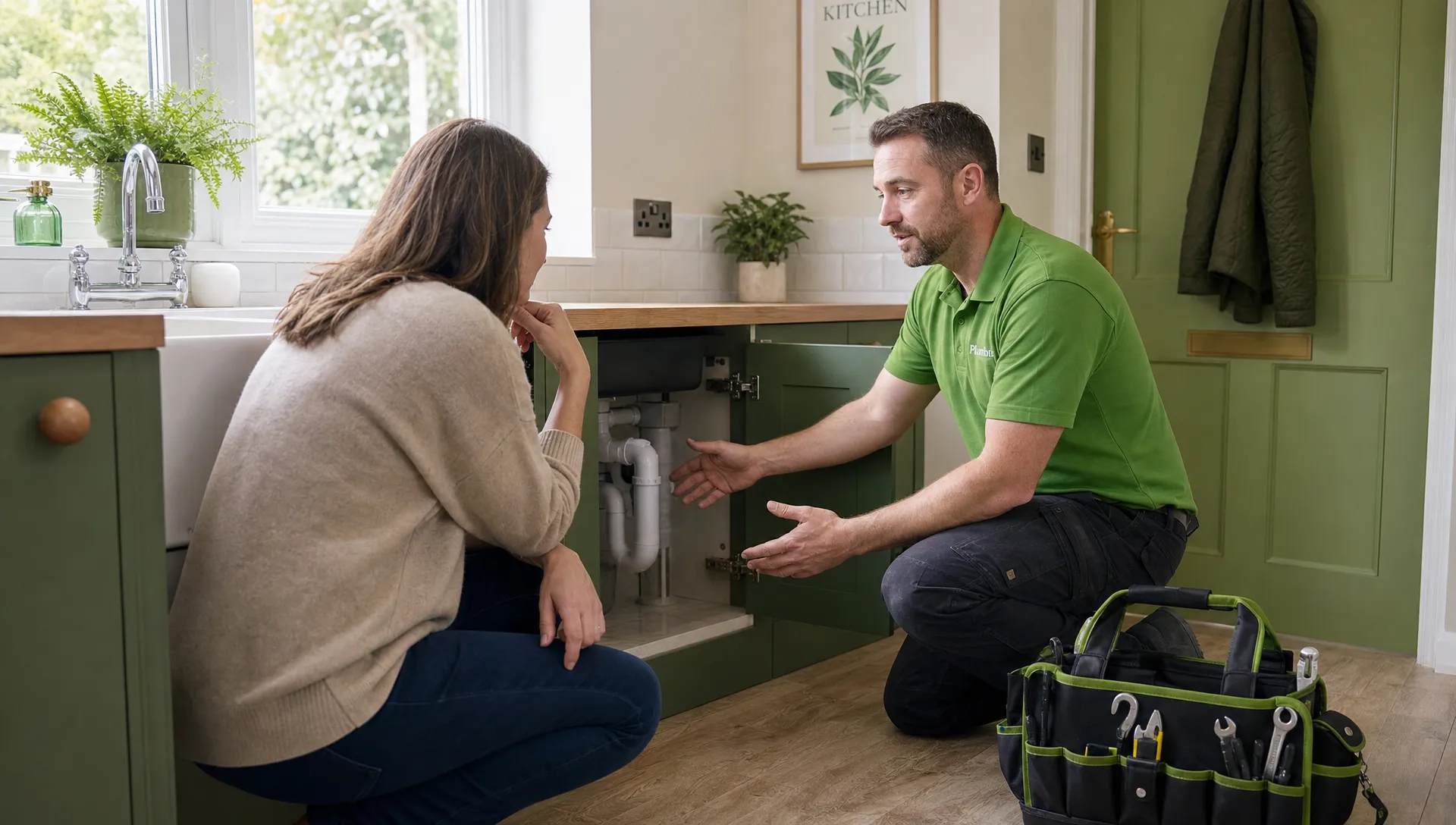
A homeowner and plumber reviewing an itemised plumbing quote at a kitchen table, with a visible sink pipe, notebook, tools and a neat sample of pipe fittings laid out for discussion.

6. Who will actually do the work, and when?

Sometimes the person who gives the quote is not the person who turns up. That is not automatically a problem, but you should know who will be in your home and who is responsible for the standard of work.

Ask whether the plumber will attend personally or send a colleague. If more than one person is involved, ask who your main contact will be and whether all workers are qualified for the tasks they will carry out.

It is also worth confirming the expected start date, arrival window and how long the job is likely to take. For landlords and property managers, ask whether they can contact tenants directly, provide notice where needed and send updates once the job is complete.

7. How will you diagnose the problem, and what does the call-out fee include?

For emergency leaks, boiler issues, blocked toilets or low water pressure, the first visit may involve diagnosis rather than immediate repair. This is normal, but the charging structure should be clear.

Ask whether there is a call-out fee, what it includes and when the hourly rate begins. If the plumber needs specialist equipment, such as leak detection tools or drain cameras, ask whether that is included or charged separately.

A trustworthy plumber should be able to explain their process in simple terms. For example, they might isolate the water supply, test pressure, inspect visible pipework and then advise whether further investigation is needed.

8. What parts and materials will you use?

Parts vary in quality, availability and warranty. A cheaper part is not always poor quality, and a premium part is not always necessary, but the choice should be explained.

Ask whether the quote includes all parts and whether the plumber will use like-for-like replacements or recommend an upgrade. For taps, valves, pumps, toilets, radiators and shower components, it helps to know whether the parts are standard and easy to source if they ever need replacing.

If you are buying materials yourself, check that the plumber is happy to fit them. Some tradespeople will not guarantee customer-supplied parts, because they cannot control the quality or compatibility.

9. What guarantee do you provide on labour and parts?

A professional plumber should be clear about what is guaranteed and for how long. There may be one guarantee for labour and a separate manufacturer's warranty for parts.

Ask what happens if the same fault returns after the visit. Will they come back free of charge if it is related to their workmanship? Are there situations where a return visit would be chargeable, such as a new blockage caused by misuse or a separate fault elsewhere in the system?

Get the guarantee in writing where possible, especially for larger jobs. It does not need to be complicated, but it should be clear enough that both sides understand it.

10. What paperwork or certification will I receive?

For simple jobs, an invoice may be all you need. For gas, heating, landlord or regulated work, paperwork becomes much more important.

If gas work is involved, ask what Gas Safe documentation will be provided. If you are a landlord, make sure the plumber or heating engineer understands what records you need for your rental property. For unvented hot water cylinders or certain heating upgrades, ask whether any building control notification, certificate or compliance paperwork applies.

Good paperwork helps if you later sell the property, make an insurance claim, manage a tenancy or need another tradesperson to understand what has been done.

Red flags to watch for before you book

Most plumbers are honest, hardworking tradespeople, but it still pays to be alert. Be cautious if something feels rushed, vague or unusually cheap without explanation.

Common warning signs include:

  • Refusing to provide a written quote for anything beyond a very small job
  • Asking for a large cash payment upfront before any work or materials are supplied
  • Being unclear about qualifications for gas or specialist work
  • Avoiding questions about insurance, guarantees or paperwork
  • Pressuring you to decide immediately when the job is not an emergency
  • Giving a price that is far below other quotes without explaining why

A low quote is not always a bad quote. The key is whether you understand what is included, what is excluded and what could change.

How to compare plumbing quotes fairly

Once you have answers from two or three plumbers, compare like with like. A cheaper quote may exclude parts, VAT, waste removal or follow-up visits. A higher quote may include better materials, faster availability or a longer guarantee.

Do not judge on price alone. Look at the full picture: experience, reviews, communication, insurance, clarity and whether the plumber has explained the job in a way you understand.

For homeowners, this helps avoid paying more than necessary. For landlords and property managers, it also helps reduce repeat call-outs, tenant disruption and unclear invoices.

If your plumbing job overlaps with another trade, it is worth checking the right specialist before you book:

  • Compare heating engineer rates if the job involves a boiler, radiator system or gas appliance.
  • Compare electrician rates if the plumbing work includes an electric shower, pump wiring or controls.
  • Compare builder rates if you are planning a bathroom renovation, drainage alteration or structural work.

Frequently asked questions

Should I choose the cheapest plumber? Not automatically. The cheapest quote may be good value, but only if it includes the same labour, parts, insurance, VAT and guarantee as the others. Compare the detail, not just the total.

How many plumbing quotes should I get? For non-urgent work, getting two or three quotes is sensible. For emergencies, you may need to move faster, but you should still ask about call-out fees, hourly rates and insurance before booking.

Do plumbers need to be Gas Safe registered? Only if they are doing gas work. A plumber can carry out water plumbing without being Gas Safe registered, but any work on gas appliances or gas pipework must be done by someone on the Gas Safe Register.

Should I pay a deposit before plumbing work starts? A small deposit can be reasonable for larger jobs or special-order materials. Be cautious about paying a large amount upfront, especially in cash, before any work has started.

Can landlords use the same questions when hiring a plumber? Yes. Landlords should also ask about tenant access, emergency response times, invoices, certificates and any safety paperwork needed for the property.

Ready to compare plumbers with confidence?

The right plumber should be able to answer these questions clearly and calmly. If the price, qualifications or scope of work feels vague, take a step back and compare your options.

With HaMuch, you can check real local pricing data, compare vetted tradespeople with genuine customer reviews and request quotes for free, with no obligation to book. Start by comparing plumber rates in your area, then choose the professional who feels right for the job.

How Much Does It Cost to Hire a Plumber in Manchester?

Plumber fitting pipework in a home in Manchester

If you’re trying to work out what a plumber in Manchester should actually cost, you’re not alone. Prices vary more than most homeowners expect, and it’s easy to end up either overpaying or underestimating a job before it’s even started. Here’s a straightforward breakdown of what to expect, and how to make sure you’re getting a fair price.

Average Plumber Costs in Manchester

Most plumbers in Manchester charge by the hour, with day rates common for bigger jobs. As a rough guide:

  • Call-out fee: £40 to £70, often waived if you go ahead with the work
  • Hourly rate: £45 to £75, depending on experience and the complexity of the job
  • Half-day rate: £150 to £250
  • Full-day rate: £250 to £450

Emergency or out-of-hours call-outs (burst pipes, no hot water on a weekend) typically cost more, sometimes 25 to 50 percent on top of standard rates.

These figures move around depending on the job itself. A dripping tap is a very different cost to a full bathroom re-plumb, so it’s worth getting a specific quote rather than working off averages alone.

What Affects the Price?

A few things tend to push the cost up or down:

  • Job complexity – straightforward repairs cost less than installations or full replacements
  • Access – awkward pipework behind walls or under floors takes longer to reach
  • Parts and materials – some plumbers include these in their quote, others charge separately
  • Timing – evening, weekend, and emergency call-outs usually carry a premium
  • Local demand – like most cities, rates can vary by area within Greater Manchester

Why Prices Can Vary So Much Between Quotes

This is where things get confusing for a lot of homeowners: two plumbers can quote wildly different prices for what sounds like the same job. Sometimes that’s down to experience or overheads, but sometimes it’s simply because there’s no standard rate card in the trade, and prices are rarely published anywhere.

This is one of the reasons we built HaMuch around actual rate data rather than guesswork. Instead of asking around and hoping for the best, you can see real, comparable pricing from plumbers already working in your area, so you know roughly what you should be paying before you even pick up the phone.

How to Hire a Plumber Without Overpaying

  1. Get more than one quote. Even two or three quotes will show you where the going rate actually sits.
  2. Ask what’s included. Materials, VAT, and call-out fees aren’t always itemised upfront.
  3. Check reviews, not just star ratings. A high score with vague reviews tells you less than a handful of detailed ones.
  4. Confirm the total before work starts. A clear price for the job, not just an hourly estimate, avoids surprises.
  5. Ask about guarantees. Reputable plumbers will stand behind their work for a set period.

Compare Plumber Prices in Manchester

Rather than ringing round for quotes one by one, you can see current rates from local, vetted plumbers directly on HaMuch, based on real pricing from tradespeople working in your area right now.

Get quotes from vetted plumbers in Manchester →


Related Cost Guides


Never mind the rogue builders: Pricing website starts rogue customer list

builders tools
  • HaMuch.com
    to compile list of debtor customers, complainers and con-men
  • Builders report increase in non-paying
    customers, rogue complainers & cancellations
  • Some customers hire tradesmen with no intention
    of paying quoted price

We are all used to seeing rogue tradesmen on early morning television shows, BBC’s Watchdog and regional news shows, but what these programmes never portray is the number of rogue customers that builders and other trades have to deal with.

Are customer who fail to pay up rogues too?

Building work-pricing website HaMuch.com is now attempting to redress the balance by compiling a list of customers who have failed to pay up, cancelled major jobs at short notice or consistently made unjustified complaints to get significant discounts. This list of nightmare customers will be compiled via feedback from plumbers, electricians, roofers, bricklayers and other tradesmen and tradeswomen who use the unique pricing website, before being made available to trades who sign up for the service.

“For far too long, the emphasis has been on the occasional bad builder,” says HaMuch.com founder Tarquin Purdie. “We hope that this list of bad customers can do something to redress the balance. A small number of customers have no intention of paying a quoted price in full and will pick and pick at work until the tradesman just gives in. It is certainly on the increase. Perhaps the BBC will even commission a show from Matt Allwright called Rogue Customers.”

Keep cost clear to avoid rogue customers

Purdie estimates that his users will have lost tens of thousands of pounds over the years to rogue customers. He cites cases of builders who have had to sue customers who refused to pay for an extension, one who paid for the kitchen but none of the labour to install it and another who cancelled a loft extension on the day work was to start, with all materials purchased. The list will help tradesmen and tradeswomen to avoid customers who are likely to cause them similar problems.

“I founded the site to help clean up the industry and create more transparency,” says Purdie. “We have made labour costs clear for all customers across the UK and we always act when we hear about poor tradesmen. So, this is the next step to creating a fair industry for all. We all need builders, plumbers and carpenters to work on our home and they need us. So these exchanges should always be fair and above board. We think this list will help to achieve that.”

Upgrade Your House | Twyford Bathroom Solutions

e100 bathroom suite

When it comes to renovating your bathroom, there are several important elements to consider at every stage of the process, from designing, buying and installing a new bathroom suite.  

Perhaps the most daunting decision for a homeowner is settling on a bathroom suite that both looks beautiful and performs flawlessly, while keeping in budget. Twyford bathroom ranges feature a host of ceramics and furniture solutions ideal for any space or style. From mirror cabinets, and other storage solutions to toilets, basins, and showers, form and function combine to create the perfect modern bathroom.

Practical & Durable

Whether it is the striking design of the Moda range or the combination of curves and square of the E100 collection, a Twyford bathroom is both practical and durable, stylish and stunning. Available in a range of finishes from bright white to natural wood, the wide range of furniture solutions will perfectly complement your choice of ceramic and declutter your bathroom. Complete with contemporary mirror cabinets in several convenient sizes, features include internal shelves, handy fold-down storage compartments and optional external lighting.

Space Saving

The floating effect of Twyford’s wall-hung toilets offer a sleek aesthetic and increase the sense of space, as well as providing easier cleaning for homeowners. Likewise, thanks to clever behind the wall technology, cisterns can be concealed behind the wall meaning even greater space can be created and flush plates can be located away from the cistern – perfect for smaller bathrooms. Toilet options also include a unique combination of Twyford’s cutting-edge Rimfree® and Flushwise® technologies for an ultra-hygienic, clean and green solution.

Much as you’d expect from a name built on outstanding service and exceptional bathroom solutions, Twyford’s expert team ensures smooth and efficient running of your project from start to finish, working closely with your installer to create the bathroom of your dreams.

To find out more about Twyford bathrooms, visit www.twyfordbathrooms.com.

Builders and Plumbers in the southeast 25 times more expensive

Regional / local: The UK’s cheapest tradesmen are in Birmingham / Nottingham / Nuneaton / Blackwood / Doncaster

  • North-south divide in builder costs as much as £240-per-hour
  • Surrey and London most expensive for tradesmen/women
  • Midlands offers best value to homeowners, according to HaMuch.com

A new data survey by building work pricing site HaMuch.com has revealed the stark differences between the southeast and the rest of the UK when it comes to the cost of building work. The divide appears to be drawn at Watford Gap, with the Midlands offering best value, whilst Surrey and London have the most expensive tradesmen.

The spread of prices for common household jobs across the recently-launched website’s 12,000 tradesmen ranged from £10-per-hour to an incredible £250-per-hour, with builders in Surrey charging as much as 25-times more than their counterparts in Nottingham. Plumbers in Surrey also charged an eye-watering 20-times more than those in Caerphilly. Meanwhile, hiring an electrician in London could cost you £250-per-hour, compared with a bargain basement £10-per-hour in Birmingham. 

The startling prices were uncovered by the data processing team for https://www.hamuch.com as part of their efforts to ensure that homeowners know the cost of jobs up-front. The website lists a labour cost for each tradesman/tradeswoman listed on the service and allows homeowners to search trades in their area by cost, so that no one busts their budget building an extension to having a boiler serviced. So if you are searching ” heating engineer near me

“We knew there was a wide disparity in charges between the southeast and the rest of the UK, but we were shocked just how wide that was”, says HaMuch.com founder Tarquin Purdie. “The prices show that the market can take a lot in the southeast, whereas rates in parts of the Midlands and north may not have increased for several years. It is certainly something that will make the industry and even government ministers sit up and pay attention.

“We are committed to making sure homeowners and renters alike know the cost of a job before they even approach a plumber or a painter. Not all builders and trades will like it, but we think that the best are only too happy to be honest and up-front on costs.”

The most inexpensive painter and decorator and carpenter both charged £10-per-hour and were in Nuneaton and Doncaster respectively. The most costly were in Brighton and Islington, at £150 and £100. 

The full breakdown of low and high prices is as follows:

Building work: Cheapest, £10-per-hour in Nottingham, East Midlands. Most costly, £250-per-hour in Camberley, Surrey.

Electricians: Cheapest, £10-per-hour in Birmingham, West Midlands. Most costly, £250 in Edgware, London. 

Plumbing:  Cheapest, £10-per-hour in Blackwood, Caerphilly. Most costly, £200-per-hour in Addlestone, Surrey. 

Painting and decorating: Cheapest, £10-per-hour in Nuneaton, Warwickshire. Most costly, £150-per-hour in Brighton, East Sussex. 

Carpenters: Cheapest, £10-per-hour in Doncaster, South Yorkshire. Most costly, £100 in Islington, London. 

Banish Builder cash-in-hand payments for trades

money
  •  HaMuch.com announce New Year’s resolution is no more cash-in-hand for builders
  • Portable card machines have revolutionised payment for tradespeople
  • Does away with the industry’s reputation for tax-dodging

Building work pricing website HaMuch.com is set to put a cat among the building site pigeons by calling time on cash-in-hand payments for plumbers, electricians and bricklayers alike. 

The bundle of used notes was once standard payment for tradesmen, but the website’s founder Tarquin Purdie believes that abandoning cash payments for 2019 will allow builders to fully embrace the 21st century and rescue the industry’s reputation in one fell swoop. He is now calling for home-owners to reject calls for cash payment, even if that comes with a discount.

“It’s not hard to see why builders have traditionally dealt in cash,” says HaMuch.com Managing Director Tarquin Purdie. “They have to buy materials and pay sub-contractors and that was traditionally all done with cash. But now they buy on-account or with credit cards, and their sub-contractors or workers all have bank accounts. Many builders used cash work to stay under the VAT threshold – and I have some sympathy with that for the one-man business – but a good building business should be VAT registered nowadays, withthe accounting wherewithal to deal with that.”

Purdie points to the prevalence of iZettle and other portable card readers among many tradesmen, with modern technology also allowing them to scan receipts and manage their money far better than their forebears. Tradespeople may have been seen as luddites in the past, but they now receive work via smartphone apps, advertise on social media and use WhatsApp to send images to customers. 

“If they are offering you a substantial cash discount, then that is nothing to do with convenience or cashflow,” says Purdie. “HaMuch.com was founded to make pricing clear for customers and builders alike, but we understand some firms may offer a small discount to get the work. However, anyoneoffering as much 10% or 15% cash discount nowadays is asking you to be complicit in tax-avoidance. It is as simple as that. Ask your tradesman for their bank account details, or simply use their card reader.”

Purdie expects the growth of the ‘cashless society’ will see far fewer customers feeling the pressure to pay cash for the likes of plumbing, roofingglazing or gardening work. Although he recognises that some tradesmen may be reluctant to let go of cash payments.

“There will always be a handful of builders who want to have that roll of fifties to pull out in the pub on a Friday night,” he says. “But more and more home-owners are joining up the dots between that cash discount and how the NHS or local services may miss out on the lost tax money.”

Scourge of Festive Veg Causing Spike in Christmas Call-outs for Tradespeople

christmas tradesman callout

From Brussel Sprouts blocking sinks to red-wine stained carpets and furniture, tradesmen at www.hamuch.com have revealed the most common reasons they’re contacted by panicking homeowners over the festive period.

The poll of 1,000 tradespeople from cleaners to plumbers has also revealed an 18% spike in the number of call-outs over this period, as people struggle to cope with the aftermath of the frenzied festive period.

Pete, a plumber at www.hamuch.com, said: “Homes have suffered over the Christmas period with blockages being a common issue. Dishwashers and sinks regularly need to be unclogged and the remnants of a festive dinner removed from the pipes….People can panic, particularly if they’ve tried to tackle the problems themselves but just end up making things even worse!”

What’s important to bear in mind is that a call-out over the Christmas period, particularly on the big day itself, can result in heftier charges than usual.

Tarquin Purdie, Founder & MD of pricing website www.hamuch.com said: “Accidents do happen and things can go wrong for no apparent reason, resulting in people needing to call in a tradesman.

“Household problems do not confine themselves to times when we are not relaxing at home with the family such as the festive period, and they even seem to spike during this period. This is probably because there is more demand on household appliances, more people using the house, and also there is more leftover food and rubbish to dispose of.”

Tarquin added: “The important thing to remember is that you can get a tradesman out over Christmas, but the call-out charge will be higher. Consumers should factor that in and decide whether any non-urgent issue can wait until after Christmas.”

Here are the Top Festive Aftermath issues identified by tradespeople at www.hamuch.com:

Upgrade Your House: Upgrade Your Bathroom – Design Tips

bathroom upgrades

If you want to do upgrades to your house, your bathroom is often one of the best starting points. It is the one of the most popular rooms in the house, and one that will be used on a daily basis. That’s why you should carefully plan any bathroom upgrades and get the help of a professional if you want to do a decent bathroom renovation.

When renovating your bathroom, it is important to keep your budget in mind, to ensure that you can have a proper job done without compromising on quantity.

Here are a few great bathroom design tips from experts:

  • Try to stick to your existing layout, in order to avoid any additional costs to move plumbing around.
  • Think about how your bathroom will be used; if you love taking long baths, spend money on a decent bath to enjoy for years to come.
  • If you have a big family or entertain guests regularly, be sure to use quality fittings and never cut corners as this will easily start to show.
  • Keep an eye out for specials, even though it may take a bit longer to finish, it will save you money in the end.

Experts will also help you to save money when it comes to your walls and floors. They will show you different types of tiles that have a very realistic wood or stone effect but are much cheaper than real stone and wood. Plus, these tiles look great, they are very durable, and they come in a wide variety of designs that are perfect for your bathroom.

When it comes to sanitaryware, never go for cheap products; a cheap toilet for example, can often have a compromised flushing capability, which can lead to other issues down the line. An expert builder or designer can help you choose quality products for your bathroom renovation that will perfectly suit your specific bathroom layout.

If baths aren’t your thing, try to save money by purchasing a cheaper bath and rather spend time on a luxurious shower. If you don’t have space for both, you can choose to have a shower-bath installed that will offer the comfort of a both but the convenience of a shower.

Looking for a bathroom upgrade? Visit HaMuch to find an expert to help you upgrade your bathroom and improve your home.