Need help with a job?

Find affordable tradespeople

Need help with a job?

HaMuch is Excellent

Currently Viewing Posts in Heating Engineer

Strong Smell of Gas Near the Boiler

Strong Smell of Gas Near the Boiler

If there is a strong smell of gas near the boiler, treat it as a gas emergency straight away. Do not try to find the leak, relight the boiler, reset it or test anything yourself. Call the National Gas

If there is a strong smell of gas near the boiler, treat it as a gas emergency straight away. Do not try to find the leak, relight the boiler, reset it or test anything yourself.

Call the National Gas Emergency Service on 0800 111 999 from outside the property or from a safe place. The service is free to call and operates 24 hours a day. You should also arrange for a Gas Safe registered heating engineer to inspect the boiler or gas appliance once the property has been made safe.

What to do right now

If you can smell gas now, take these steps calmly and in this order:

  • Call the National Gas Emergency Service on 0800 111 999.
  • Open doors and windows if you can do so without delaying your exit.
  • Turn off the gas at the emergency control valve by the meter if it is safe and easy to reach.
  • Do not use naked flames, matches, cigarettes or candles.
  • Do not turn electrical switches on or off, including lights, plug sockets, extractor fans or the boiler controls.
  • Do not use a phone inside the property.
  • Leave the property and wait outside, away from doors, windows and the gas meter.

The Gas Safe Register’s emergency advice is clear: if you smell gas, call the emergency number first. That comes before calling a tradesperson, landlord, managing agent or boiler manufacturer.

If someone is unwell, has collapsed, is struggling to breathe or you think there is an immediate danger, call 999 from outside the property.

Who should you call for a gas smell near a boiler?

There are two different roles to understand.

The National Gas Emergency Service deals with the immediate risk. An emergency engineer may attend to check for a gas escape and make the property safe. This can include isolating the gas supply. They may not repair your boiler or reconnect an appliance if it is unsafe.

A Gas Safe registered heating engineer deals with the boiler, gas pipework connected to it and any repair, replacement or safety inspection needed afterwards. For a boiler-related gas smell, this is usually the main trade you need after the emergency has been handled.

A general plumber is not enough unless they are also Gas Safe registered for the type of gas work required. Gas work in the UK must be carried out by someone on the Gas Safe Register, and you can ask to see their Gas Safe ID card before any work starts.

Once the immediate danger has been dealt with, you can use HaMuch to compare local heating engineer rates and see transparent pricing information before deciding who to contact.

Possible causes once the property is safe

You should not try to diagnose the cause while you can still smell gas. The table below is only to help you understand what the emergency engineer or Gas Safe registered heating engineer may be looking for after the area has been made safe.

Possible cause Who usually deals with it What may happen next
Gas escaping from a boiler connection Gas Safe registered heating engineer The boiler may be isolated until the fault is repaired and tested
Fault inside the boiler Gas Safe registered heating engineer The engineer may repair the part, test the appliance or advise replacement
Gas smell from the meter area National Gas Emergency Service first The supply may be checked, isolated or referred for further work
Recent boiler service, repair or installation issue Gas Safe registered heating engineer The previous work may need inspecting and making safe
Smell drifting from another gas appliance National Gas Emergency Service first, then a relevant Gas Safe engineer The source must be confirmed before any appliance is used again
A smell that is not gas, such as drains or chemicals Emergency gas check first if you are unsure If gas is ruled out, another trade such as a plumber or ventilation engineer may be needed

A smell of gas near the boiler is often described as sulphur-like or similar to rotten eggs. Natural gas has an added smell so leaks are easier to notice. If you are in any doubt, treat it as gas until a qualified person tells you otherwise.

What not to do while waiting

The most common mistake is trying to “just check” the boiler. Do not remove the boiler cover, press reset repeatedly, relight a pilot light, adjust controls or look for the leak with a flame. These actions can make the situation more dangerous.

Do not assume the smell will clear on its own because the boiler is off. Gas can still escape from pipework, valves or the meter area even when an appliance is not running.

You should also avoid turning appliances on or off. That includes lights, the cooker, extractor fans, washing machines, tumble dryers and plug sockets. If something is already on, leave it as it is and get out.

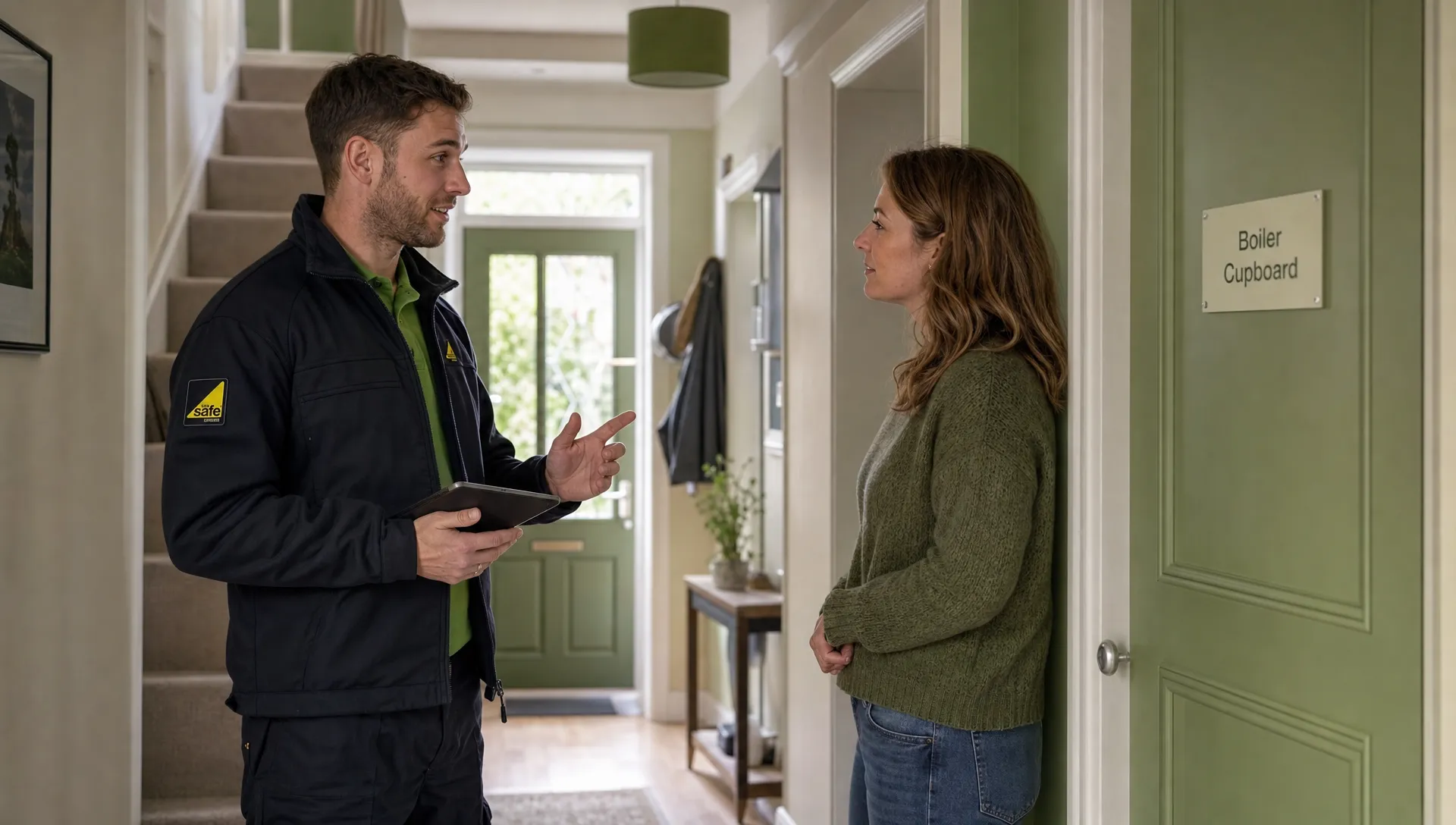
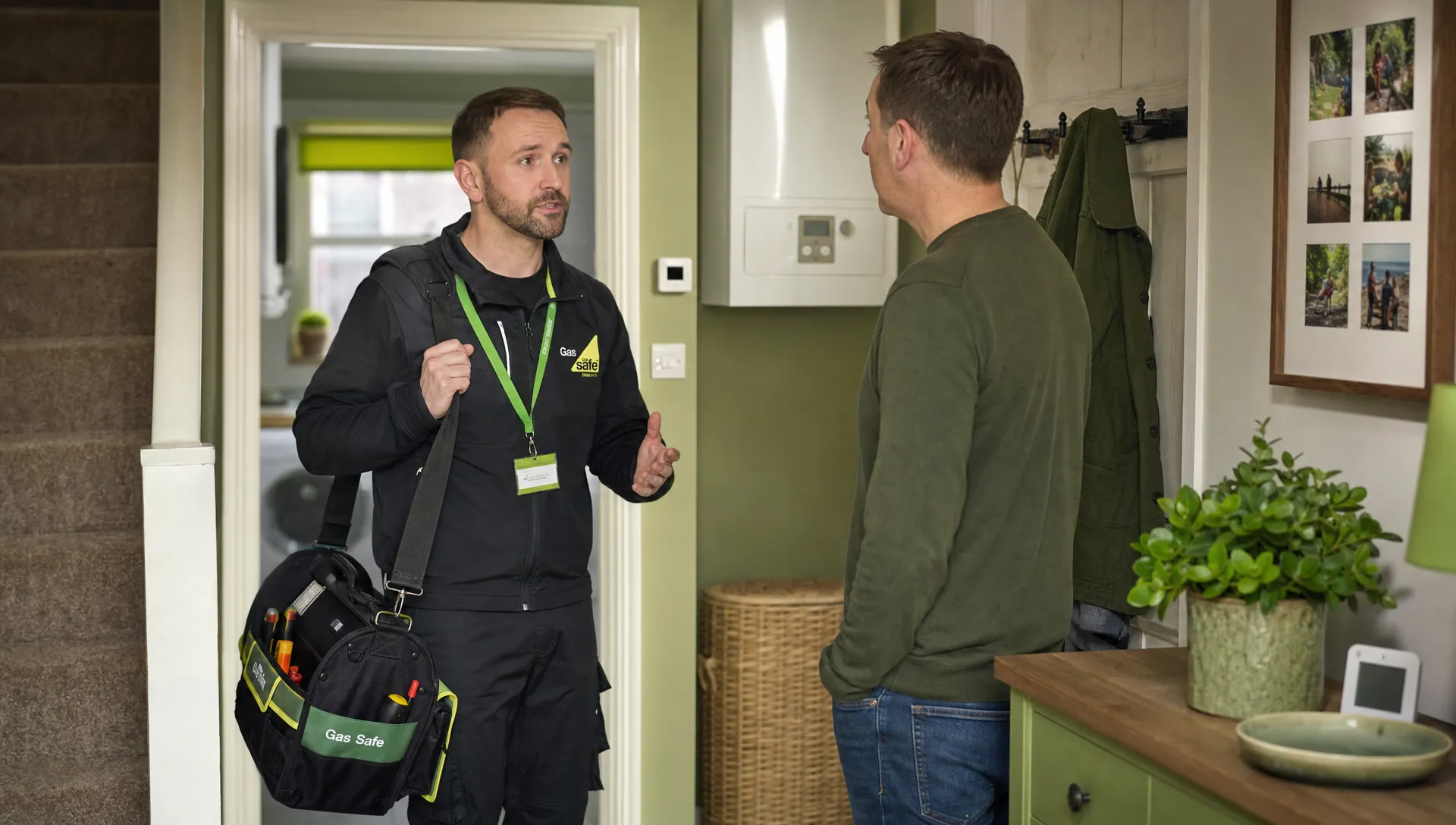
A Gas Safe heating engineer speaks calmly with a homeowner in a British hallway while the boiler cupboard stays closed nearby.

What happens after the emergency visit?

After an emergency call-out, you may be told that the gas supply has been isolated or that the boiler must not be used. This can feel inconvenient, especially if you rely on the boiler for heating and hot water, but it means the immediate risk has been controlled.

The next step is normally to book a Gas Safe registered heating engineer. They can inspect the boiler, identify the fault and explain whether it is a repair, service issue or replacement decision.

The follow-up work might be one of the following:

Follow-up job Typical reason Trade to use
Boiler safety inspection Gas supply has been isolated or appliance has been switched off Gas Safe registered heating engineer
Boiler repair A faulty component or connection has been identified Gas Safe registered heating engineer
Annual boiler service The boiler is due a routine service after being checked safe Gas Safe registered heating engineer
Boiler replacement The boiler is unsafe, uneconomical to repair or at the end of its life Gas Safe registered heating engineer

If the engineer recommends a service after the emergency issue has been resolved, HaMuch’s guide to annual boiler service costs can help you understand what is usually included. If the boiler is beyond economical repair, you can also check the guide to new boiler installation costs before comparing quotes.

How much will it cost to put right?

The cost depends on what the emergency engineer finds and what the Gas Safe registered heating engineer needs to do afterwards. A quick inspection is very different from a parts replacement, full boiler repair or new boiler installation.

Factors that can affect the final price include:

  • Whether the visit is during normal working hours or out-of-hours.
  • Whether the gas supply has been isolated and needs further testing.
  • The age, make and model of the boiler.
  • Whether parts are needed.
  • Your location and local labour rates.
  • Whether more than one gas appliance needs checking.

This is where HaMuch is useful once the urgent safety step is complete. Instead of working from vague estimates, HaMuch shows real, comparable pricing by trade and location, alongside local tradesperson listings and customer reviews. You can compare before you book and choose the heating engineer that suits the job.

Advice for landlords and tenants

If you are a tenant and you smell gas near the boiler, do not wait for the landlord before taking emergency action. Call the National Gas Emergency Service on 0800 111 999 first, leave the property and then contact your landlord or letting agent.

Landlords must keep gas appliances, flues and pipework in a safe condition. The Health and Safety Executive explains landlord duties under the Gas Safety (Installation and Use) Regulations, including annual gas safety checks by a Gas Safe registered engineer.

For landlords and property managers, a reported gas smell should be treated as urgent. Once the emergency service has attended, arrange follow-up work quickly and keep clear records of advice, isolation notices, engineer visits and any completed repairs.

Can you prevent this happening again?

Not every gas smell can be prevented, but regular boiler care reduces the chance of faults being missed. Have the boiler serviced by a Gas Safe registered heating engineer, keep landlord gas safety checks up to date and do not ignore small or occasional gas smells.

A carbon monoxide alarm is also sensible near sleeping areas and in rooms with fuel-burning appliances, but remember that carbon monoxide itself has no smell. A gas smell near the boiler and a carbon monoxide alarm are different warning signs, and both need immediate attention.

If your boiler has been repaired after a gas smell, ask the engineer what caused the issue, whether any parts were replaced and whether any further monitoring is needed. Keep paperwork for future servicing, especially if you own a rental property.

Frequently asked questions

Is a gas smell near the boiler always an emergency? Yes. If you can smell gas, call the National Gas Emergency Service on 0800 111 999 first. Do not try to decide whether the smell is serious yourself.

Can I turn the boiler off if I smell gas? Do not touch the boiler controls or any electrical switches. If you can safely turn off the gas at the emergency control valve by the meter without delaying your exit, do that, then leave and call from outside.

Should I call a plumber or a heating engineer? For a boiler-related gas smell, you need a Gas Safe registered heating engineer after the emergency has been made safe. A plumber should only do gas work if they are Gas Safe registered for that work.

What if the smell disappears before anyone arrives? Still call the emergency number if you smelled gas. A leak can be intermittent, and the source needs to be checked by the right person before the boiler or gas supply is used again.

Can my landlord tell me to wait until morning? If you smell gas, call the National Gas Emergency Service immediately. Tell your landlord or letting agent afterwards so they can arrange the required follow-up with a Gas Safe registered engineer.

Need a Gas Safe heating engineer after the emergency call?

If you can smell gas now, call 0800 111 999 before doing anything else.

Once the National Gas Emergency Service has made the property safe, post the follow-up boiler job on HaMuch. You can compare local heating engineers, check transparent pricing information and read genuine customer reviews before choosing who to contact. For a gas smell near a boiler, act urgently, use the emergency number first and only book Gas Safe registered help for the repair or inspection.

Radiator Cold at the Top But Hot at the Bottom

Radiator Cold at the Top But Hot at the Bottom

If your radiator is cold at the top but hot at the bottom, the good news is that the most common cause is simple: trapped air. Hot water is still reaching the lower part of the radiator, but air has c

If your radiator is cold at the top but hot at the bottom, the good news is that the most common cause is simple: trapped air. Hot water is still reaching the lower part of the radiator, but air has collected at the top, stopping that section from heating properly.

In many homes, this can be sorted by bleeding the radiator. It is usually a quick job, but there are a few situations where it is better to stop and call a professional, especially if the problem keeps coming back, several radiators are affected, or your boiler pressure drops.

Quick answer: what does a cold top mean?

A water-filled central heating radiator should heat fairly evenly from top to bottom once the system has been running for a while. When the bottom is hot but the top stays cool or cold, air is normally sitting in the top of the radiator.

What you notice Most likely cause Who usually handles it What to do next
One radiator cold at the top but hot at the bottom Trapped air Homeowner, heating engineer if unsure Bleed the radiator safely
Several radiators cold at the top Air in the system or low pressure Heating engineer or plumber Check boiler pressure and get advice if unsure
Radiator warms after bleeding but goes cold again Recurring air, corrosion, pressure issue or small leak Heating engineer or plumber Book a central heating check
Radiator has cold patches at the bottom too Sludge or poor circulation Heating engineer or plumber Ask about system cleaning or balancing
No heating, no hot water, or boiler fault code Boiler, pump or control issue Gas Safe registered heating engineer if gas boiler Do not open the boiler, call a qualified professional
Electric radiator is cold at the top Not a bleedable wet radiator issue Electrician Do not try to bleed it

This guide assumes you have a normal water-filled radiator connected to a central heating system. If you have an electric radiator, storage heater, or panel heater, do not try to bleed it, as it works differently.

Why radiators go cold at the top

Central heating radiators work by filling with hot water from your boiler or heat source. Air can enter or form inside the system over time. Because air rises, it gathers at the top of the radiator. That trapped air takes up space where hot water should be, so the top section stays cold while the lower section heats up.

This can happen after a radiator has been removed and refitted, after plumbing work, after the heating has been off for a long period, or simply as the system ages. It is also common at the start of colder weather, when heating systems are switched back on more regularly.

A small amount of air in one radiator is not usually a sign of a major failure. However, frequent air build-up can point to another problem, such as corrosion inside the system, incorrect pressure, poor circulation, or a small leak letting air in.

Is it safe to keep the heating on?

If one radiator is partly cold at the top but the rest of the heating works normally, it is usually not an emergency. You can normally continue using the heating until you have time to bleed the radiator. The room may simply take longer to warm up.

You should be more cautious if you notice water leaking, a sudden drop in boiler pressure, unusual boiler noises, repeated fault codes, or no heating across the property. In those cases, avoid guessing and get a heating engineer to check the system.

If you ever smell gas, stop troubleshooting immediately. Open doors and windows, avoid flames and electrical switches, leave the property if needed, and call the National Gas Emergency Service on 0800 111 999. The Gas Safe Register gas emergency advice explains what to do and why only Gas Safe registered engineers should work on gas appliances.

How to bleed a radiator that is cold at the top

Bleeding a radiator releases trapped air. It is a common homeowner job, but only do it if you feel comfortable. If you are a tenant, check with your landlord or managing agent first, particularly if the boiler pressure needs topping up afterwards.

  1. Turn the heating off: Let the radiator cool enough to touch comfortably. Bleeding a radiator while the pump is running can draw more air into the system.
  2. Protect the floor: Put a towel under the bleed valve and hold a small container nearby to catch water.
  3. Find the bleed valve: This is usually at the top corner of the radiator. Use a radiator key or the correct tool for your valve.
  4. Open it slowly: Turn the valve a small amount anticlockwise. You should hear a hissing sound as air escapes.
  5. Close it when water appears: Once water starts to dribble steadily, close the valve gently. Do not overtighten it.
  6. Check the boiler pressure: On sealed systems, bleeding can lower the pressure. If the pressure is below the recommended range in your boiler manual and you are not sure how to top it up, call a heating engineer.
  7. Turn the heating back on: After the system has run for a while, check whether the radiator now heats evenly.

Never remove the bleed valve completely. If water sprays out, the valve will not close, or the radiator leaks afterwards, turn the heating off and get help.

What if bleeding does not fix it?

If the radiator heats properly after bleeding, you may not need to do anything else. But if the same radiator keeps becoming cold at the top, or more radiators start doing it, there is probably an underlying issue.

One common cause is low system pressure. Many modern boilers work on a sealed system, which needs the right pressure to circulate water properly. Bleeding radiators releases air, but it can also reduce pressure. If the pressure keeps dropping after you top it up, there may be a leak or a boiler-related fault.

Another possibility is corrosion inside the heating system. Over time, metal radiators and pipework can react with oxygen in the water. This can produce gas and sludge. The gas can collect at the top of radiators, while sludge often causes cold patches lower down. A heating engineer or plumber may recommend cleaning, adding inhibitor, or checking whether the system needs balancing.

If only radiators far from the boiler are affected, the problem may be circulation rather than trapped air alone. A pump issue, partially closed valve, or unbalanced system can leave some rooms colder than others. These are not usually DIY jobs because the cause needs to be diagnosed properly.

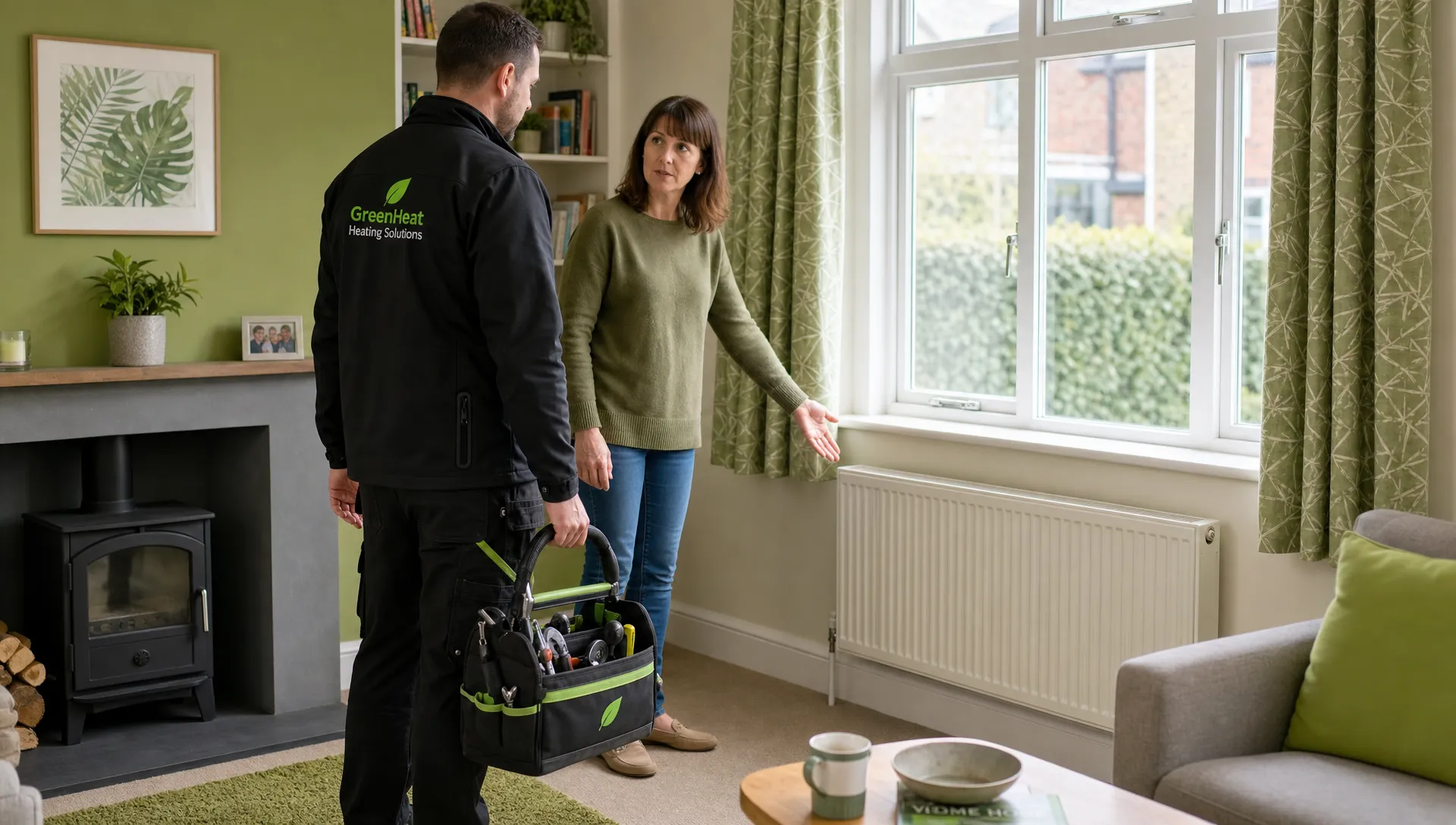
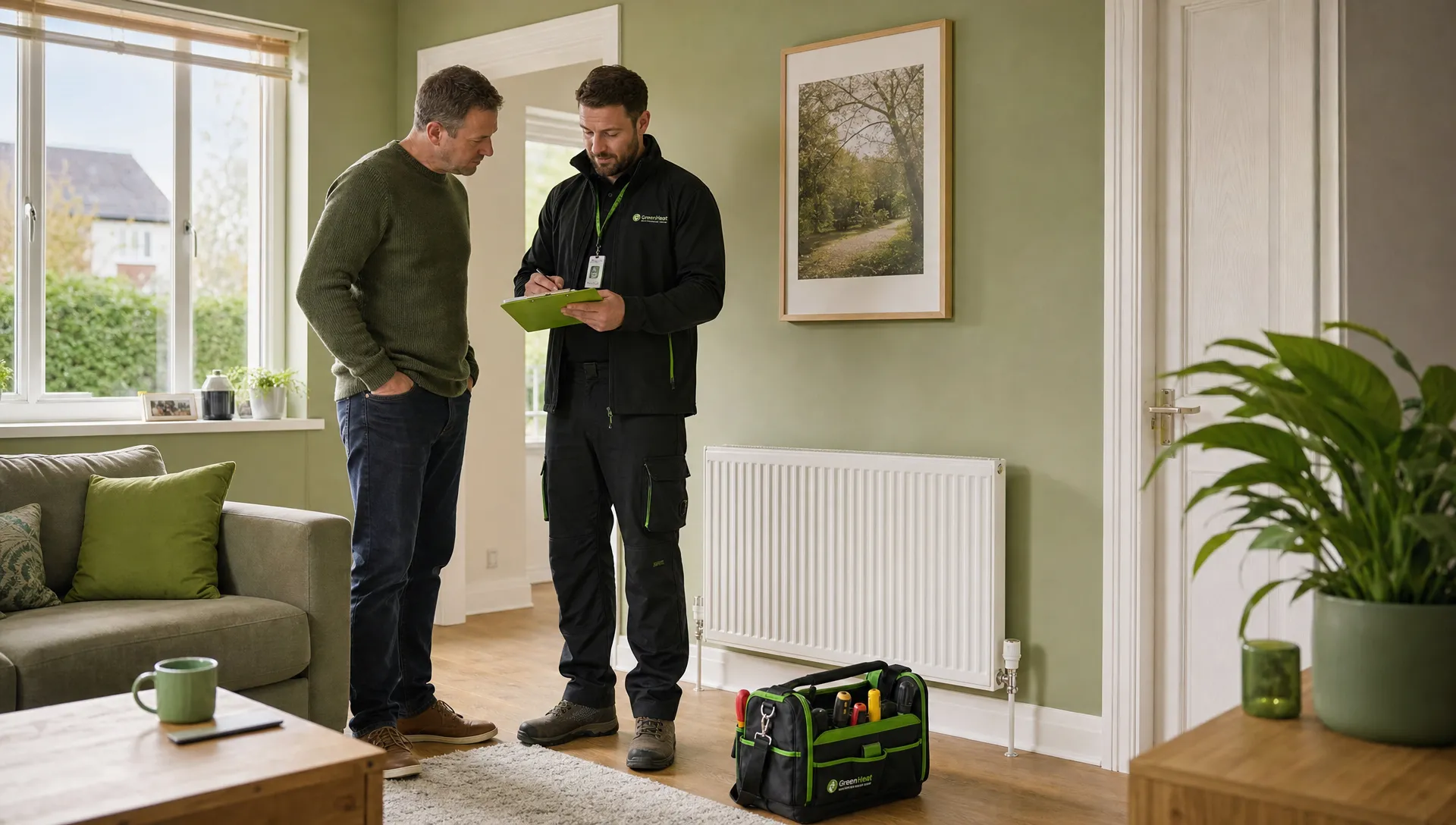
A UK living room with a wall radiator in the background, a homeowner standing nearby while a heating engineer with a tool bag checks notes on a clipboard, with natural daylight and an ordinary lived-in home setting.

Which trade should you call?

For a radiator cold at the top, the most relevant trade is usually a heating engineer. A plumber can also help with many radiator and central heating pipework issues, especially if there is a visible leak at a radiator valve or nearby pipework. If the problem involves the boiler, gas supply, flue, combustion, or a gas appliance casing, you need a Gas Safe registered heating engineer.

HaMuch is useful here because you can compare real, transparent rates before you book, rather than having to make a blind enquiry and wait for vague estimates. If you are in London, Birmingham, Manchester, or surrounding areas, you can compare current heating engineer rates on HaMuch by trade and location before deciding who to contact.

If the problem looks more like a plumbing repair, such as a leaking radiator valve, damp flooring around the radiator, or pipework that needs attention, you can also check local plumber rates so you know what a fair call-out or hourly rate looks like in your area.

When it is more than a simple trapped-air problem

A single radiator cold at the top is normally straightforward. The following signs suggest it is time to get a professional opinion rather than repeatedly bleeding the radiator.

Sign What it may mean Best next step
You need to bleed the same radiator every few weeks Air or gas is being created or entering the system Ask a heating engineer to check pressure, corrosion and leaks
Boiler pressure keeps dropping Possible leak, pressure vessel issue or boiler fault Book a qualified heating engineer
Several upstairs radiators are affected Air collecting at high points or pressure too low Get the central heating system checked
Radiator water is very dark when bled Sludge or corrosion in the system Ask about cleaning, inhibitor and balancing
Radiator is cold at the bottom as well Sludge, blocked valve or poor circulation Heating engineer or plumber diagnosis needed
Boiler shows a fault code Boiler or control issue Use a Gas Safe registered heating engineer for gas boilers

The key point is not to keep treating the symptom if it returns quickly. Regular air in the system can reduce heating efficiency, make rooms uncomfortable, and point to problems that are cheaper to deal with before they get worse.

What to tell the tradesperson before they arrive

A clear description helps the tradesperson diagnose the issue faster. Before posting the job or calling someone out, make a note of what you have noticed.

  • Which radiator is affected and whether it is upstairs or downstairs.
  • Whether the top is cold but the bottom is hot, or whether there are cold patches elsewhere.
  • Whether you have already bled the radiator and what happened.
  • Whether the boiler pressure has changed.
  • Whether other radiators, hot water, or the boiler display are affected.
  • Whether you have seen leaks, damp patches, or staining near radiators.

Photos can also help, but avoid opening boiler covers or removing radiator parts. A professional does not need you to dismantle anything before they arrive.

Advice for landlords and property managers

For landlords, a radiator cold at the top can start as a minor comfort issue, but it should still be dealt with promptly, especially in colder months. Tenants may be able to describe the symptom, but you should be careful about asking them to repressurise boilers or carry out repeated bleeding if they are not confident.

If the same property has repeated radiator air problems, it is worth getting the system checked properly rather than arranging quick fixes every time. This is particularly important in rental properties where heating reliability affects tenant safety, comfort and legal responsibilities.

Using HaMuch can help landlords and managing agents compare local tradespeople, see customer reviews, and understand likely pricing by location before booking work across multiple properties.

How to reduce the chance of it happening again

Some trapped air is normal, but good maintenance can reduce repeat problems. Bleed radiators at the start of the heating season if they are not warming evenly. Keep an eye on boiler pressure after any bleeding. If you have a gas boiler, arrange servicing by a Gas Safe registered engineer in line with the manufacturer’s guidance and legal requirements for rented homes.

If radiators often need bleeding, ask a heating engineer whether the system has the correct inhibitor, whether it needs balancing, or whether sludge is affecting circulation. These checks can improve comfort and help the system run more reliably.

Frequently Asked Questions

Why is my radiator cold at the top but hot at the bottom? The most common reason is trapped air. Air rises to the top of the radiator and stops hot water filling that section properly.

Can I bleed the radiator myself? Yes, many homeowners can bleed a radiator safely if they turn the heating off, open the bleed valve slowly, and close it when water appears. If you are unsure, or if the boiler pressure drops, call a heating engineer.

How long should it take to bleed a radiator? The bleeding itself often takes only a few minutes. Allow extra time for the heating to cool first and for checking the boiler pressure afterwards.

What if the radiator is cold at the bottom instead? A radiator cold at the bottom is more often linked to sludge, a blockage, or poor circulation rather than trapped air. That usually needs a heating engineer or plumber to diagnose.

Will bleeding a radiator affect boiler pressure? It can. Releasing air and a small amount of water may reduce pressure on sealed systems. If you do not know how to check or top up the pressure safely, get professional help.

Do I need a plumber or a heating engineer? For trapped air and central heating performance, a heating engineer is usually the best fit. A plumber may be suitable for radiator leaks or valve issues. Anything involving a gas boiler must be handled by a Gas Safe registered engineer.

Is a radiator cold at the top dangerous? On its own, it is not usually dangerous. However, leaks, boiler faults, pressure loss, no heating, or any smell of gas should be treated seriously and checked quickly.

Need someone to check your radiator?

If bleeding the radiator does not solve it, the problem keeps returning, or you simply want a professional to deal with it, post the job on HaMuch. You can compare local heating engineers and plumbers, see genuine reviews, and check transparent pricing before you decide who to hire.

For active leaks, no heating in cold weather, or any boiler concern you are not confident about, do not wait. Get a qualified local tradesperson to inspect the system and make it safe.

Boiler Making a Loud Banging Noise: What It Means

Boiler Making a Loud Banging Noise: What It Means

If your boiler is making a loud banging noise, it is understandable to worry. The good news is that many causes are fixable, especially if you stop using the boiler before the problem gets worse. The

If your boiler is making a loud banging noise, it is understandable to worry. The good news is that many causes are fixable, especially if you stop using the boiler before the problem gets worse. The important thing is knowing when it is safe to do a simple check, and when you need a Gas Safe registered heating engineer urgently.

A banging boiler can point to anything from trapped air in the heating system to a circulation fault, limescale build-up, loose pipework, or delayed ignition. Some are not immediately dangerous, but any noise that is new, very loud, repeated, or paired with a gas smell, burning smell, leak, pressure loss, or boiler lockout should be taken seriously.

First: when to switch the boiler off

Before trying to work out the cause, use the noise and any other symptoms to decide whether the boiler should stay off.

What you notice What to do
A single loud bang or boom when the boiler fires up Turn the boiler off and arrange a Gas Safe registered heating engineer. This can be delayed ignition.
Banging plus a smell of gas Do not use the boiler. Open windows, avoid switches and flames, leave the property if needed, and call the National Gas Emergency Service on 0800 111 999.
Banging plus a carbon monoxide alarm, dizziness, headaches, nausea, or breathlessness Leave the property and get emergency help. Do not use the boiler again until it has been checked by a Gas Safe registered engineer.
Repeated banging, kettling, rumbling, or clunking while heating is on Turn the boiler off if the noise is severe, then book a heating engineer inspection.
Mild ticking or clicking as pipes warm up and cool down This may be normal expansion, but book a check if it is getting louder or has recently started.
Banging after taps, showers, washing machines, or dishwashers stop running This may be water hammer, usually a plumber or heating engineer job.

For gas emergencies, follow Gas Safe Register’s gas emergency advice and do not remove the boiler casing or attempt repairs yourself. In the UK, work on a gas boiler must be carried out by a Gas Safe registered engineer.

What a loud banging boiler usually means

A boiler should not sound like someone knocking inside it. Occasional gentle ticking from pipes can happen as metal expands and contracts, but loud bangs, thuds, clunks, or a kettle-like rumble usually mean something in the heating system is not behaving as it should.

The cause is often one of three broad issues:

  • Water is not moving smoothly through the boiler or heating system.
  • Heat is building up in the wrong place because of sludge, limescale, or a faulty part.
  • Pipework is moving or shaking when water flow changes suddenly.

Most boiler banging noises are handled by a heating engineer, especially if the noise is coming from the boiler itself. If the banging seems to come from pipework when taps or appliances stop, a plumber may be the right first call. If you are unsure, describe when the bang happens and where it sounds loudest when requesting quotes.

You can compare local pricing before booking by checking HaMuch’s heating engineer rates, including live, comparable rates across the UK rather than relying on vague estimates. If the problem turns out to be pipework rather than the boiler, HaMuch also lists plumber rates so you can see typical local pricing before deciding who to contact.

The most likely causes of a boiler making a banging noise

Kettling from limescale or sludge

Kettling is one of the most common explanations for a boiler making a banging noise. It can sound like rumbling, popping, knocking, or a kettle boiling. It happens when water inside the boiler is not flowing properly, so heat builds up and creates steam bubbles or pressure changes.

In hard water areas, limescale can build up inside the boiler’s heat exchanger. In older central heating systems, sludge and debris can also restrict water flow. London and parts of the South East are particularly known for hard water, so kettling can be more common there, although it can happen anywhere.

This is usually a heating engineer job. The engineer may check circulation, water quality, filters, valves, and whether the system needs cleaning or further treatment. Do not try to open the boiler or descale internal parts yourself.

Trapped air in the heating system

Air in radiators or pipework can cause knocking, gurgling, bubbling, or banging noises, especially when the heating first comes on. You may also notice radiators that are cold at the top but warm at the bottom.

Some homeowners are comfortable bleeding radiators, but it should be done carefully and only if you know how to repressurise your boiler afterwards using the manufacturer’s instructions. If the pressure keeps dropping, the banging continues, or you are not confident, call a heating engineer.

Repeated air in the system can point to a leak, pressure issue, or another fault that needs proper diagnosis.

Low boiler pressure or pressure changes

Low pressure can stop water circulating properly, which may lead to banging, clunking, poor heating, or the boiler switching itself off. A pressure gauge reading below the normal range shown in your boiler manual may be a clue.

Topping up pressure can be a simple task on some boilers, but not all systems are the same. If the pressure drops again after topping up, there may be a leak, faulty expansion vessel, or pressure relief issue. Those are jobs for a heating engineer.

Pump or circulation problems

The pump helps move hot water around your heating system. If it is failing, blocked, incorrectly set, or struggling against sludge in the system, the boiler may heat water faster than it can move away. That can lead to banging or overheating noises.

You might also notice radiators taking a long time to warm up, some rooms staying cold, or the boiler starting and stopping more often than usual. A heating engineer can test the pump and circulation without guessing.

A Gas Safe heating engineer with a tool bag standing in a lived-in UK hallway, speaking calmly with a homeowner near the boiler area from a normal room distance, with no close-up of boiler parts or pipework.

Loose or expanding pipework

Sometimes the boiler is blamed when the noise is actually coming from the central heating pipes. Pipes can knock against joists, floorboards, walls, or clips as they heat up and cool down. This often sounds like tapping, ticking, or knocking from under floors or behind walls.

If the noise only happens as the heating warms up, then fades, it may be expansion. If the banging is loud, sudden, or worsening, pipework may need securing, insulating, or rerouting. A plumber or heating engineer would usually investigate this. If floorboards or boxing need repair afterwards, a carpenter or joiner may be needed too, but they are not usually the first trade to call.

Water hammer

Water hammer is a sharp bang caused by a sudden change in water flow. It often happens when a tap is turned off quickly, a washing machine stops filling, or a valve closes suddenly. The bang may sound like it is coming from near the boiler, but the issue is usually in the plumbing pipework.

A plumber can check water pressure, pipe support, valves, and any devices that may be causing the shock. A heating engineer may be involved if the banging is connected to heating controls or hot water components.

Delayed ignition

Delayed ignition is one of the more serious possibilities. It can cause a loud bang or boom when a gas boiler starts. This may happen because gas builds up briefly before igniting. It is not something to monitor or test repeatedly.

If the boiler bangs when firing up, turn it off and book a Gas Safe registered heating engineer. If you also smell gas, treat it as a gas emergency and call 0800 111 999.

Faulty thermostat, valve, or boiler control

Controls help the boiler know when to fire, stop, and move water through the system. A faulty thermostat, motorised valve, diverter valve, or internal sensor can cause odd heating behaviour, short cycling, pressure changes, or banging.

These faults are difficult to diagnose by sound alone. A heating engineer can test the system safely and identify whether the issue is with the boiler, controls, valves, or wider heating system.

What you can safely check before calling someone

There are a few safe observations you can make without touching the boiler internals. These can help the tradesperson understand the problem more quickly.

  • Note when the bang happens: when the boiler fires up, when heating is running, when hot water is used, or when taps and appliances stop.
  • Check whether the noise is from the boiler casing area, radiators, walls, floors, airing cupboard, or pipework.
  • Look at the boiler display for error codes or warning lights, then write them down.
  • Check the pressure gauge against the normal range in your boiler manual, without opening the boiler casing.
  • Feel whether radiators are cold at the top, cold at the bottom, or uneven across the house.
  • Check for obvious leaks around radiators, visible pipes, or the boiler area, but do not remove covers.

If you are a landlord or property manager, ask the tenant to record when the noise happens and whether there are any error codes, but arrange a qualified inspection promptly. Boiler problems in rental properties can affect heating, hot water, and safety, so it is better not to let a loud new noise run on for days.

Which trade should you call?

For most boiler banging noises, the right trade is a heating engineer. If it is a gas boiler, make sure they are Gas Safe registered. A plumber may be the better first call if the bang clearly happens after taps, toilets, showers, washing machines, or dishwashers stop running, because that points more towards pipework and water hammer.

Symptom pattern Most likely trade
Loud bang when the boiler ignites Gas Safe registered heating engineer
Rumbling or kettling while boiler is running Heating engineer
Banging with low pressure or repeated pressure loss Heating engineer
Gurgling radiators and uneven heat Heating engineer
Sharp bang when taps or appliances stop Plumber, sometimes heating engineer
Tapping from under floors as heating warms up Plumber or heating engineer
Boiler beyond economical repair Heating engineer or boiler installer

If the engineer finds that the boiler is old, unreliable, or unsafe to repair, replacement may be discussed. Before making that decision, it is worth checking what affects new boiler installation costs so you can compare repair versus replacement properly.

Will a boiler service fix a banging noise?

Sometimes, but not always. A standard annual service is mainly about checking the boiler’s safe operation, condition, and performance. It may reveal signs of poor combustion, leaks, pressure issues, or wear, but a loud banging noise may need diagnostic work beyond a routine service.

If your boiler has not been serviced recently, booking one is sensible, especially before winter. HaMuch has a separate guide to annual boiler service costs if you want to understand what is usually included. When you contact an engineer, be clear that there is an active banging noise, not just a routine service request, so they allow time to investigate.

How urgent is a banging boiler?

A mild tapping sound that has been present for years may not be urgent. A new, loud, repeated bang is different. The more severe, sudden, or unusual the sound is, the sooner you should get it checked.

Treat it as urgent if:

  • The boiler bangs when it fires up.
  • The noise is getting louder or more frequent.
  • The boiler locks out, shows an error code, or loses pressure.
  • You notice leaks, burning smells, soot marks, or scorch marks.
  • There is a gas smell or carbon monoxide alarm.
  • You have vulnerable occupants relying on heating or hot water.

For a gas smell, do not post a normal job request first. Call the National Gas Emergency Service on 0800 111 999. After the immediate emergency has been dealt with, you can arrange a Gas Safe registered engineer to inspect and repair the boiler.

How to explain the problem when requesting quotes

You do not need to know the technical cause before asking for help. A clear description is enough. Include the boiler make and model if you know it, the age of the boiler, when it was last serviced, where the noise seems to come from, and whether it happens during heating, hot water, or start-up.

Also mention your location, because labour rates vary across the UK. A heating engineer in London may charge differently from one in Birmingham or Manchester, and HaMuch is built to show real, comparable local pricing so you can make a more informed decision before booking.

This is especially useful if you are managing more than one property, because you can compare tradespeople by area, rate, and reviews rather than starting from scratch each time.

Frequently asked questions

Is a banging boiler dangerous? It can be. Some causes, such as trapped air or loose pipework, are usually less serious. Others, such as delayed ignition, overheating, or gas-related faults, need urgent attention. If the bang is loud, new, or happens when the boiler fires up, turn it off and call a Gas Safe registered heating engineer.

Can I keep using my boiler if it is banging? If the sound is loud, repeated, or unusual, it is safer to stop using the boiler until it has been checked. If there is a gas smell, carbon monoxide alarm, burning smell, leak, or error code, do not use it.

Why does my boiler bang when the heating comes on? Common causes include trapped air, sludge, limescale, pump problems, pressure issues, or delayed ignition. The timing of the bang matters, so note whether it happens at start-up, during heating, or when the system switches off.

Who fixes a boiler making a banging noise? Most boiler noises need a heating engineer. If it is a gas boiler, the engineer must be Gas Safe registered. If the bang is linked to taps or appliances turning off, a plumber may be needed for water hammer or pipework issues.

Can bleeding radiators stop boiler banging? It may help if trapped air is the cause, but it will not fix limescale, sludge, pump faults, delayed ignition, or pressure problems. If bleeding radiators does not solve it, or the pressure keeps dropping, book a heating engineer.

Need a heating engineer now?

A loud banging boiler is not something to ignore, especially if it is new or happening when the boiler starts. If you smell gas, call 0800 111 999 immediately and follow emergency gas safety advice.

For non-emergency banging, post the job on HaMuch and compare local Gas Safe registered heating engineers before you book. HaMuch helps you see transparent, comparable pricing and genuine customer reviews, so you can choose with more confidence rather than guessing what a fair call-out or hourly rate should be.

How Much Does a New Boiler and Fitting Cost?

How Much Does a New Boiler and Fitting Cost?

A new boiler is one of those home improvements where the appliance price only tells half the story. What most homeowners and landlords really need to know is the new boiler and fitting cost, because t

A new boiler is one of those home improvements where the appliance price only tells half the story. What most homeowners and landlords really need to know is the new boiler and fitting cost, because the final bill includes the boiler, labour, materials, safety checks, controls, waste removal and sometimes extra pipework.

As a practical UK guide, a standard new boiler and fitting will often cost around £2,000 to £5,500 for many like-for-like replacements. More complicated work, such as changing from an old hot water cylinder system to a combi boiler, moving the boiler to a new room, or removing an old back boiler, can cost £6,000 or more.

The safest way to budget is to compare quotes from qualified local heating engineers, not just look at the price of the boiler online. HaMuch is built for exactly that: helping you see real, comparable local prices before you decide who to contact.

Quick answer: typical new boiler and fitting costs

The figures below are broad UK guide prices for a gas boiler supplied and fitted. Your quote may be higher or lower depending on the boiler brand, property size, flue position, controls, pipework and where you live.

Boiler job Typical fitted cost What it usually includes
Combi boiler replacement in the same position £2,000 to £3,500 New combi boiler, basic materials, labour, testing and removal of the old boiler
Higher output or premium combi boiler fitting £2,800 to £4,500 Larger or higher-spec boiler, often for bigger homes or higher hot water demand
System boiler replacement £2,500 to £4,500 Boiler replacement while keeping a hot water cylinder
Regular or heat-only boiler replacement £2,500 to £5,000 Boiler replacement for a traditional system with cylinder and tanks
Converting from a regular/system boiler to a combi £3,500 to £6,000+ Removing or bypassing tanks/cylinder, extra pipework and more labour
Back boiler removal and modern boiler fitting £4,000 to £7,000+ Removing an old back boiler and fitting a modern wall-mounted boiler system
Moving a boiler to a new location Add around £500 to £1,500+ Extra pipework, flue changes, condensate route and making good, depending on distance

For a fuller breakdown by boiler type and installation complexity, HaMuch also has a dedicated new boiler installation cost guide that goes deeper into replacement and conversion prices.

Why the fitted price matters more than the boiler price

It is easy to find a boiler online for a fixed appliance price, but that number does not mean much on its own. A boiler sitting in a box is not a working heating system.

The fitted price is the figure that matters because it includes the work needed to install it safely and legally. For gas boilers, that work must be carried out by a Gas Safe registered engineer. You can check registration details through the official Gas Safe Register, and you should never allow unregistered gas work in your home or rental property.

A proper quote for new boiler and fitting should normally set out what is included, what is excluded, and whether VAT is included. If two quotes look very different, check the detail before assuming one engineer is expensive and another is cheap. One may include upgraded controls, a system clean, extra pipework or a longer manufacturer warranty, while another may only cover the basics.

What should be included in a new boiler fitting quote?

A clear quote should make it obvious what you are paying for. If anything is vague, ask the heating engineer to spell it out before you agree to the job.

Most new boiler and fitting quotes should include:

  • The boiler make, model and output size
  • Labour to remove the old boiler and fit the new one
  • Standard flue and fittings, where required
  • Basic pipework and valves needed for the installation
  • Connection to existing heating and hot water pipework
  • Heating controls, if included in the quote
  • Filling, testing and commissioning the boiler
  • Disposal of the old boiler and packaging
  • Building Regulations notification, where required
  • Details of the manufacturer warranty or guarantee

The quote should also say if anything is not included. Common exclusions can include redecorating, boxing in pipework, repairing walls or floors, upgrading radiators, removing large hot water cylinders, or major changes to gas pipe routes.

Main factors that affect the cost

No two homes are exactly the same, which is why fixed national prices can be misleading. The following factors usually have the biggest effect on what you pay.

Boiler type and size

A small flat with one bathroom will usually need a different boiler from a four-bedroom house with two bathrooms. A larger output boiler generally costs more to buy and may take longer to fit, especially if the current pipework or controls need upgrading.

Combi boilers are popular because they provide heating and hot water from one unit without a separate cylinder. However, they are not automatically the best choice for every home. Larger properties with strong hot water demand may be better suited to a system boiler and cylinder. A good heating engineer should size the boiler to the property, not simply replace the old one with the same output.

Like-for-like replacement or conversion

A like-for-like replacement in the same position is usually the simplest and cheapest option. The engineer removes the old boiler, fits the new one in roughly the same place, connects it to the existing pipework, tests it and registers the installation.

A conversion takes more time. For example, changing from a traditional boiler with a hot water cylinder to a combi boiler may involve removing tanks, altering pipework, changing controls and adapting the heating system. That extra labour and material cost is why conversions are often much more expensive than straightforward swaps.

Boiler location and flue route

Keeping the boiler in the same place usually keeps the cost down. Moving it to a loft, garage, utility room or different wall can add a significant amount because the engineer may need to run new gas, water and condensate pipework.

The flue route matters too. A simple flue through an external wall is usually easier than a more complex route through a roof or awkward space. If scaffolding, specialist access or extra making good is needed, expect the quote to rise.

Controls and smart thermostats

Modern controls can make your heating easier to manage, but they affect the quote. Some boiler packages include basic controls, while others price them separately. Smart thermostats may add to the upfront cost, but many homeowners like the convenience of controlling heating from a phone and setting more accurate schedules.

Ask what controls are included and whether they are compatible with the boiler and your heating system. If you are comparing quotes, make sure you are comparing the same level of controls.

Local labour rates

Labour costs vary across the UK. Parking, travel time, congestion, local demand and business overheads all affect pricing.

Area Why prices may differ Where to compare local rates
London Higher travel, parking and overhead costs can push fitting quotes up Check London heating engineer rates
Birmingham Costs can vary between central areas, suburbs and surrounding towns Check Birmingham heating engineer rates
Manchester Demand, access and property type can affect fitted boiler pricing Check Manchester heating engineer rates

This is where HaMuch differs from many comparison sites. Instead of leaving you to guess, HaMuch shows transparent, comparable pricing information so you can sense-check quotes before booking.

A Gas Safe heating engineer with a tool bag and clipboard talks with a homeowner at the open front door of a modest UK terraced house, with natural daylight, everyday clutter and no close-up view of pipework or boiler parts.

How long does a new boiler fitting take?

A straightforward boiler swap in the same position can often be completed in one day, although some jobs take longer. A more involved replacement may take two days. A conversion, relocation or back boiler removal can take several days depending on the layout and how much pipework needs changing.

Time matters because labour is a major part of the final cost. If one engineer quotes for a one-day swap and another quotes for three days, ask why. There may be a good reason, such as extra system cleaning, access difficulties or additional safety work.

For landlords, timescale also affects tenants. If the property is occupied, ask how long the heating and hot water will be off, whether temporary arrangements are needed, and how the engineer will manage access.

Should you buy the boiler yourself?

Some homeowners wonder whether buying the boiler separately will reduce the fitted cost. It can work in a few cases, but it is not always the best route.

Many heating engineers prefer to supply the boiler because they know which models they are happy to install, can source compatible flues and controls, and can handle warranty registration more easily. If you buy the boiler yourself, you may be responsible if parts are missing, the appliance is unsuitable, or the warranty process becomes more complicated.

Before buying a boiler online, ask your chosen engineer whether they are willing to fit customer-supplied boilers and whether the warranty would still be straightforward. A slightly cheaper appliance price can become poor value if it causes delays or warranty issues.

New boiler costs for landlords and rental properties

Landlords and property managers usually have a slightly different set of priorities. Price still matters, but so do reliability, documentation and tenant disruption.

For a rental property, make sure the quote covers all necessary safety checks, commissioning paperwork and Building Regulations notification. You will also need to keep your annual gas safety responsibilities separate from the installation itself. A new boiler does not remove the need for ongoing checks and maintenance.

It is also worth planning around void periods where possible. Replacing a boiler between tenancies can be less stressful than arranging work around tenants, especially if access is limited or the property is in a managed block.

After fitting, keep copies of the invoice, warranty, service instructions and safety paperwork. These records are useful for future maintenance, tenant queries and property management.

Is a new boiler always the right choice?

Not always. If your boiler is fairly modern and the fault is minor, a repair may be more sensible. But replacement often becomes worth considering when the boiler is old, unreliable, expensive to repair, inefficient, or when parts are becoming hard to source.

A heating engineer can inspect the system and explain whether repair or replacement is the better option. Be cautious of anyone who pushes an immediate replacement without explaining the fault, likely repair cost and realistic life left in the existing boiler.

If you do go ahead, plan for maintenance from the start. An annual service helps keep the boiler safe, supports warranty conditions and can catch small issues early. You can see typical prices in HaMuch’s annual boiler service cost guide.

How to compare new boiler and fitting quotes fairly

The cheapest quote is not always the best quote, and the highest quote is not automatically the safest. The aim is to compare like with like.

Before you choose an engineer, check:

  • Whether the engineer is Gas Safe registered for the type of work
  • The exact boiler make, model and output being quoted
  • Whether controls, flue, filters and system cleaning are included
  • Whether VAT is included or added later
  • How long the work will take and when it can start
  • What warranty is included and who registers it
  • Whether old materials and waste will be removed
  • Whether the quote includes making good, or only installation work

If you receive several quotes, place them side by side and look for missing details. A quote that seems low may exclude controls or system cleaning. A higher quote may include a better warranty or extra work that another engineer has not allowed for.

This is also why upfront pricing information is so useful. With HaMuch, you can compare local tradesperson rates and customer reviews before requesting quotes, giving you a clearer starting point than guesswork alone.

Ways to keep the cost sensible without cutting corners

There are sensible ways to manage the cost of a new boiler and fitting, but safety and quality should not be compromised.

The easiest win is to avoid unnecessary changes. If the current boiler location works well and is safe, keeping the new one in the same place will usually be cheaper than moving it. Planning ahead can also help, because emergency winter replacements often leave you with fewer options and less time to compare quotes.

It is also worth being clear about what you actually need. A larger or more expensive boiler is not automatically better. The right boiler is the one correctly sized for your home, hot water demand and heating system.

Finally, ask more than one qualified heating engineer to quote. You do not need to choose purely on price, but multiple quotes help you understand the fair range for your property and location.

Frequently asked questions

How much does a new boiler and fitting cost in the UK? Most standard new boiler and fitting jobs cost around £2,000 to £5,500, depending on the boiler type, property size and installation complexity. Conversions, relocations and back boiler removals can cost more.

Is fitting included when I buy a new boiler? Not always. Some prices are for the boiler only, while others are fully fitted packages. Always check whether labour, flue, controls, materials, testing, waste removal and VAT are included.

Can any plumber fit a gas boiler? No. Gas boiler work must be carried out by a Gas Safe registered engineer who is qualified for the type of gas work required. Always check their registration before the job starts.

How long should a new boiler installation take? A simple like-for-like boiler replacement may take one day. A conversion, relocation or back boiler replacement can take two or more days, depending on the work involved.

Do landlords need extra paperwork after a new boiler is fitted? Landlords should keep the invoice, warranty details, Building Regulations notification and any safety paperwork. Annual gas safety duties still apply after the new boiler is installed.

Ready to compare new boiler and fitting quotes?

Before you agree to a boiler quote, compare real local pricing and reviews so you know what is reasonable for your area. HaMuch helps homeowners, landlords and property managers find vetted local heating engineers, compare transparent prices and request quotes without obligation.

Start by using HaMuch to compare local tradesperson prices and request boiler fitting quotes from heating engineers near you.

How Much Does an Annual Boiler Service Cost in London?

How Much Does an Annual Boiler Service Cost in London?

For a standard gas boiler, an annual boiler service in London usually costs around £90£140. If you need a landlord gas safety record at the same appointment, budget roughly £110£180. Oil boilers, urge

For a standard gas boiler, an annual boiler service in London usually costs around £90-£140. If you need a landlord gas safety record at the same appointment, budget roughly £110-£180. Oil boilers, urgent appointments and awkward access can cost more.

That is a practical London budgeting range, not a fixed price. The best way to know what is fair for your postcode is to compare real local rates before you book. HaMuch lets you check transparent pricing for a heating engineer in London, so you can see what local tradespeople charge rather than relying on vague national averages.

If you want the wider UK picture as well, HaMuch also has a full annual boiler service cost guide covering common service types across the country. This article focuses on what changes when the job is in London.

Typical boiler service costs in London

Most London homeowners booking a routine annual service for a gas combi, system or regular boiler should expect a quote in the low hundreds, provided the boiler is working and easy to access.

Boiler service job in London Typical budget What to know
Standard annual gas boiler service £90-£140 For a routine service on a working domestic boiler
Larger, older or more time-consuming gas boiler service £110-£170 More likely if the boiler has not been serviced recently
Landlord gas safety check only £70-£120 A legal safety check, not always the same as a full service
Boiler service plus landlord gas safety record £110-£180 Common for rental properties when arranged together
Oil boiler service £140-£240 Less common in London and often more specialist
Urgent or out-of-hours attendance £140-£250+ Usually more expensive than a planned annual service

Always check whether VAT, parking, congestion charges or certificate paperwork are included. A quote that looks cheap at first can end up similar to others once extras are added.

Why boiler servicing can cost more in London

London boiler service prices are often higher than in many other parts of the UK because heating engineers have higher operating costs. Travel time, parking, van running costs, insurance, local demand and time spent moving between jobs all affect the final quote.

The exact borough can also make a difference. A straightforward service in an outer London home with easy parking may cost less than the same job in a central flat where the engineer has to pay for parking, carry tools further or work around building access rules.

Other factors that can push the price up include:

  • A boiler that has not been serviced for several years
  • A very old boiler or a model that needs more care
  • Poor access, such as a boiler inside a tight cupboard
  • A service booked at short notice during winter
  • A landlord certificate needed alongside the service
  • More than one gas appliance to check at the same property

A routine service is different from a repair visit. If the engineer finds a fault, the cost of parts and repair labour will usually be quoted separately.

A Gas Safe heating engineer with a tool bag and clipboard speaking with a homeowner on the doorstep of a typical London terraced house, with natural daylight, everyday household clutter visible inside and no close-up technical details.

What should be included in an annual boiler service?

A good boiler service is not just a quick glance at the boiler. The engineer should check that the appliance is operating safely, inspect key components, test safety controls and look for signs of wear, leaks or poor combustion.

For gas boilers, the work must be carried out by a Gas Safe registered engineer. The Gas Safe Register advises that gas appliances should be checked and serviced regularly by a qualified professional. Before the appointment starts, it is sensible to ask to see the engineer's Gas Safe ID card.

A standard domestic boiler service will usually include a visual inspection of the boiler and flue, operational checks, safety checks, cleaning of parts where required by the manufacturer, and a service record. The engineer may also check boiler pressure, controls and any obvious warning signs that could lead to future breakdowns.

It will not normally include replacement parts, major repairs, a power flush, radiator balancing, moving pipework or fixing unrelated heating problems. If you want any of those jobs done, ask for a separate quote so the service price stays clear.

Homeowners vs landlords: what is the difference?

For homeowners, an annual boiler service is not usually a legal requirement. However, it is strongly recommended for safety, reliability and keeping many manufacturer warranties valid. If your boiler warranty says it must be serviced every year, missing a service could cause problems if you later need to make a claim.

For landlords, the rules are stricter. If you rent out a property with gas appliances, you must arrange an annual gas safety check by a Gas Safe registered engineer. The Health and Safety Executive explains the landlord duties for gas safety checks and records, including providing tenants with the correct record.

A landlord gas safety check is often called a CP12, although the official wording is usually Landlord Gas Safety Record. It confirms that gas appliances have been checked for safety. A full boiler service goes further because it is maintenance as well as safety checking. Many landlords choose to book both together to save time and reduce disruption for tenants.

How to compare London boiler service quotes fairly

When you compare quotes, do not look at the headline price alone. A slightly higher quote may be better value if it includes VAT, parking, a written service record and a clear appointment window.

Before booking, ask the heating engineer:

  • Is the price for a full boiler service or only a safety check?
  • Is VAT included?
  • Are parking or congestion charges included?
  • Will I receive a written service record?
  • Are you Gas Safe registered for this type of boiler?
  • How much would a follow-up repair visit cost if a fault is found?

You should also give accurate details when requesting quotes. Tell the engineer the boiler make and model if you know it, the property type, where the boiler is located, whether you need a landlord certificate and whether there are any current faults.

This is where HaMuch is useful. Instead of guessing what a fair London price might be, you can compare local tradespeople, genuine reviews and pricing information in one place. HaMuch is free for homeowners to use, and there is no obligation to book.

When should you book your boiler service?

The best time to book is usually spring, summer or early autumn, before the coldest months arrive. Heating engineers are often busiest when temperatures drop, because breakdowns increase and emergency heating jobs take priority.

If your boiler is due for its annual service in winter, do not skip it, but try to book ahead rather than waiting until you urgently need heating. For landlords, diarise the gas safety check early so you do not risk missing the renewal date.

It is also worth booking a service before buying or selling a property, before new tenants move in, or after moving into a home where you cannot see evidence of recent boiler maintenance.

What if the service shows you need a new boiler?

A boiler service may reveal that the appliance is unsafe, inefficient or becoming uneconomical to repair. That does not automatically mean you need a replacement, but it is a sign to ask clear questions.

Ask the engineer what the fault is, whether repair parts are readily available, how long the repair is likely to last and whether the boiler has any safety concerns. If replacement is recommended, take time to compare options and costs. HaMuch has a separate guide explaining new boiler installation costs if you need to plan for a bigger job.

For most working boilers, though, annual servicing is a relatively small cost compared with the inconvenience of a winter breakdown.

Frequently Asked Questions

How much does an annual boiler service cost in London? A standard annual gas boiler service in London usually costs around £90-£140. Landlord certificates, urgent visits, older boilers and difficult access can increase the price.

Is a boiler service the same as a gas safety certificate? No. A gas safety certificate, often called a Landlord Gas Safety Record, is a safety check. A boiler service is maintenance and normally includes additional checks and cleaning in line with the boiler manufacturer's instructions.

Do I need a Gas Safe engineer for a boiler service? Yes, if it is a gas boiler. Always use a Gas Safe registered engineer and ask to see their ID card before work starts.

How long does a boiler service take? A straightforward domestic boiler service often takes around 30 to 60 minutes. It can take longer if the boiler is old, hard to access or has not been maintained recently.

Are repairs included in the boiler service cost? Usually not. The service price normally covers inspection, testing and routine servicing. If faults are found, replacement parts and repair labour are normally quoted separately.

Can landlords book several boiler services together? Often, yes. If you manage several London rental properties, ask whether the engineer can group appointments by area. This may make scheduling easier, although the final price depends on the work required.

Compare London boiler service quotes with HaMuch

A fair boiler service price should be clear before you book. With HaMuch, you can compare local heating engineers, see real pricing information and read genuine customer reviews without any obligation.

If your boiler is due for its annual check, request quotes through HaMuch and compare your options before choosing a London heating engineer.

How Much Does a New Boiler Installation Cost?

How Much Does a New Boiler Installation Cost? - Main Image

If your boiler is nearing the end of its life, breaking down regularly or struggling to heat your home, the big question is simple: what will a replacement actually cost? As a broad UK guide, a new bo

If your boiler is nearing the end of its life, breaking down regularly or struggling to heat your home, the big question is simple: what will a replacement actually cost?

As a broad UK guide, a new boiler installation cost is usually around £2,000-£4,500 for a straightforward like-for-like replacement. More complicated work, such as changing from a conventional boiler with tanks to a combi boiler, moving the boiler to a new room or upgrading old pipework, can push the total to £5,000-£7,000+.

Those figures include more than the boiler itself. You are paying for the appliance, labour, fittings, flue work, controls, safety checks, removal of the old boiler and the engineer’s responsibility for signing off the installation. That is why two homes with the same boiler brand can still receive very different quotes.

Typical new boiler installation cost in the UK

The table below gives realistic guide prices for common domestic gas boiler installation jobs. Treat these as planning figures, not fixed quotes, because the layout and condition of your property make a big difference.

Type of boiler installation Typical UK installed cost What it usually involves
Combi boiler replacement, like-for-like £2,000-£4,000 Replacing an existing combi in the same position with standard flue and controls
System boiler replacement £2,500-£4,500 Replacing a system boiler connected to a hot water cylinder
Heat-only or regular boiler replacement £2,500-£5,000 Replacing a boiler that works with a hot water cylinder and cold water tanks
Conventional boiler to combi conversion £3,500-£6,500 Removing or disconnecting tanks and cylinder, altering pipework and fitting a combi
Back boiler replacement or conversion £4,000-£7,000+ Removing an older back boiler setup and installing a modern boiler elsewhere
Boiler relocation £500-£1,500+ extra Moving the boiler to another wall, cupboard, loft, garage or utility space

The cheapest installations are normally like-for-like swaps where the new boiler goes in the same place, with no major changes to pipework, flue route or heating controls. The most expensive jobs tend to involve conversions, awkward access, old systems that need cleaning, or homes that need pipework upgrades before the new boiler can run safely and efficiently.

Why location changes the price

Labour is a major part of boiler installation cost, and labour rates vary across the UK. London is often more expensive because engineers have higher operating costs, parking charges, congestion issues and heavier demand. Birmingham and Manchester can be more competitive, but prices still depend on the exact property, availability and urgency of the job.

Before you rely on a national average, it is worth checking local pricing. HaMuch shows comparable heating engineer pricing by area, including London heating engineer rates, Birmingham heating engineer rates and Manchester heating engineer rates, so you can see how your local market compares before you request quotes.

This is one of the main advantages of using HaMuch. Instead of starting with vague estimates, you can compare real, location-based pricing and then contact local tradespeople with a clearer idea of what the work should cost.

What affects the final boiler installation cost?

A boiler quote is not just a price for a box on the wall. A heating engineer has to look at the full heating system, the property layout and the safety requirements. These are the main factors that change the total.

Boiler type and size

Combi boilers are popular in UK homes because they heat water on demand and do not usually need a separate hot water cylinder. They can be cost-effective to install when replacing another combi, but they are not automatically the right choice for every home.

A small flat with one bathroom will usually need a different boiler output from a larger family house with multiple bathrooms. If the boiler is too small, it may struggle with heating and hot water demand. If it is oversized, you may pay more than necessary and run the system less efficiently. A good engineer should size the boiler properly rather than simply recommending the biggest model.

Like-for-like replacement or conversion

A like-for-like replacement is usually cheaper because much of the existing setup can remain in place. For example, swapping an old combi boiler for a new combi in the same kitchen cupboard is usually simpler than converting a traditional system to a combi.

Conversions cost more because the engineer may need to alter pipework, remove or isolate tanks, disconnect an old cylinder, fit new controls and test the whole system more extensively. The extra work can easily add a day or more to the job.

Boiler position and flue route

If your new boiler is going in the same place and the flue can exit through the same wall, installation is usually more straightforward. If the boiler is being moved, the engineer may need to run new gas, water and condensate pipework, create a new flue route and make good around the old position.

A boiler in a loft, garage or awkward cupboard can also take longer to install. Access matters because engineers need safe working space, suitable lighting and enough room to service the boiler in future.

Condition of your existing heating system

Older heating systems can contain sludge, corrosion or undersized pipework. If the system is dirty, fitting a new boiler without cleaning it may affect performance and could cause faults later. This is why engineers may recommend a chemical clean or power flush before or during the installation.

In some homes, the gas supply pipe may also need upgrading if it is too small for the new boiler. This is not a cosmetic extra. It can be required for safe operation and proper gas pressure.

What should a new boiler quote include?

A clear boiler installation quote should show exactly what is included, so you can compare like with like. If one quote is much cheaper than another, check whether it has left out important parts of the job.

A typical quote should explain:

  • The boiler make, model and output being supplied
  • Whether VAT is included
  • Labour for removing the old boiler and fitting the new one
  • Standard fittings, flue components and condensate pipework
  • Heating controls, such as a room thermostat or programmer
  • System cleaning, if included
  • Building Regulations notification and commissioning paperwork
  • Warranty registration and any servicing conditions
  • Disposal of the old boiler and waste materials

Gas boiler work must be carried out by a Gas Safe registered engineer. In England and Wales, replacement boiler installations must also comply with relevant Building Regulations, and homeowners can find general guidance on building control approval through GOV.UK.

A Gas Safe heating engineer stands in the kitchen doorway of a modest UK home, talking with a homeowner and holding a clipboard while a tool bag rests by the wall. The room feels lived-in, with a kettle, shopping bags and everyday clutter visible, and no close-up technical details.

Common extras that can increase the price

Some extras are optional upgrades. Others are necessary because of safety, warranty or system condition. The important thing is that the quote explains them clearly before work starts.

Possible extra Typical cost impact Why it may be needed
Chemical clean or power flush £300-£800 Helps remove sludge and debris from older heating systems
Magnetic filter £100-£250 Helps protect the new boiler from circulating debris
Smart thermostat or upgraded controls £150-£350 Gives better control over heating schedules and temperatures
Gas pipe upgrade £300-£1,000+ May be needed if the existing supply pipe is too small
New flue route or extensions £200-£1,000+ Needed if the boiler position or flue exit changes
Radiator valve upgrades £40-£100 per radiator Often recommended when improving heating control room by room
Making good after removal Varies Covers boxing in, plastering, decorating or cupboard changes

Do not assume an extra is unfair just because it increases the price. For example, a magnetic filter and proper system cleaning may help protect the new boiler, while a gas pipe upgrade may be a safety and performance requirement. What matters is whether the engineer has explained why the item is needed and whether it is included in the total.

How long does boiler installation take?

A straightforward combi boiler replacement in the same position can often be completed in one day, although the engineer may need longer if access is poor or the system needs cleaning.

A system boiler or heat-only boiler replacement might take one to two days. A conversion from a conventional system to a combi boiler can take two to three days, sometimes longer if tanks need removing, pipework is difficult to access or extra making good is required.

If you are a landlord, it is worth planning the work around tenant access, hot water downtime and any safety documentation you need afterwards. A new installation does not remove the need for ongoing maintenance. For future budgeting, HaMuch also has a guide to annual boiler service costs.

Should you repair or replace your boiler?

If your boiler is fairly new and the fault is minor, repair may be the sensible option. But replacement becomes more appealing when the boiler is old, parts are difficult to source, repair bills are becoming frequent or the appliance is no longer efficient enough for your home.

As a rough decision point, think about the total picture rather than a single repair bill. If you have paid for several callouts in the past year, the boiler is out of warranty and another major component has failed, putting that money towards a planned replacement may be more sensible than waiting for an emergency breakdown in winter.

You should also consider how disruptive the work will be. A planned summer installation gives you more time to compare quotes and choose a suitable engineer. An emergency winter replacement often means less choice and higher urgency.

How to compare boiler installation quotes properly

When comparing quotes, do not only look at the final number. A cheaper quote may be good value, but only if it includes the same level of work, safety checks and aftercare.

Ask each heating engineer to confirm the boiler model, warranty length, whether the system will be cleaned, whether controls are included, how long the job will take and whether Building Regulations notification is included. You should also check customer reviews and make sure the engineer is qualified for gas work.

HaMuch helps with this stage because it is designed around transparent, comparable pricing. You can see local tradesperson listings, genuine customer reviews and pricing information before deciding who to contact. It is free for homeowners to request quotes, and there is no obligation to book.

Frequently Asked Questions

How much does a new boiler installation cost in the UK? A straightforward new boiler installation usually costs around £2,000-£4,500. More complex jobs, such as conversions, relocations or back boiler replacements, can cost £5,000-£7,000+ depending on the property.

Is a combi boiler cheaper to install? A combi boiler can be cheaper when replacing an existing combi in the same position. It can be more expensive if you are converting from a system with tanks and a hot water cylinder because pipework and controls may need changing.

Can I install a gas boiler myself? No. Gas boiler installation must be carried out by a Gas Safe registered engineer. DIY gas work is unsafe and can invalidate insurance, warranties and safety certification.

Does the boiler price include labour? A proper installation quote should include both the boiler and labour, but always check. Some headline prices may exclude extras such as system cleaning, upgraded controls, flue changes or pipework alterations.

How often should a new boiler be serviced? Most manufacturers recommend an annual service, and annual servicing is often required to keep the warranty valid. Landlords also have separate gas safety responsibilities for rental properties.

Why are London boiler installation quotes often higher? London quotes are often higher because heating engineers face higher business costs, travel time, parking issues and strong demand. That is why checking local pricing is more useful than relying only on a national average.

Compare boiler installation quotes with HaMuch

A new boiler is too important to price by guesswork. Before you book, compare local heating engineers, reviews and transparent pricing so you know whether a quote looks fair for your area.

You can request free boiler installation quotes through HaMuch and compare before you decide. There is no obligation to book, and you get a clearer view of local costs before committing to the work.

How Much Does an Annual Boiler Service Cost?

How Much Does an Annual Boiler Service Cost? - Main Image

For most UK homes, the annual boiler service cost is usually £80£120 for a straightforward gas boiler that is working normally. In highercost areas, for older boilers, or where the engineer needs extr

For most UK homes, the annual boiler service cost is usually £80-£120 for a straightforward gas boiler that is working normally. In higher-cost areas, for older boilers, or where the engineer needs extra time, it can be closer to £100-£160. Oil boilers and emergency visits normally cost more.

That is the useful short answer. The better answer is that a boiler service is not just a quick tick-box job, and the price should reflect who is doing it, where you live, what type of boiler you have, and whether you need any paperwork for a rental property.

HaMuch helps with the part most homeowners find frustrating: comparing realistic local prices before you book. Instead of relying on a vague national average, you can check transparent, comparable heating engineer prices and request quotes with no obligation.

Typical annual boiler service cost in the UK

A standard annual boiler service is commonly quoted as a fixed-price visit. The engineer checks the boiler, carries out safety and performance checks, and records what they have done. If they find a fault, any repair work or replacement parts are normally quoted separately.

For a simple domestic boiler service, these are sensible 2026 budgeting figures:

Service type Typical cost What to expect
Standard annual gas boiler service £80-£120 A routine service for a working, accessible domestic boiler
Higher-cost areas or more complex visits £100-£160 Common where travel, parking, access, age or boiler condition adds time
Boiler service with landlord gas safety record £90-£150 Often arranged in the same visit, but check exactly what is included
Oil boiler service £120-£220 Usually more involved and may need a specialist oil boiler engineer
Emergency or out-of-hours attendance £120-£250+ Best avoided for routine servicing if you can book ahead

If you are comparing prices, make sure you are comparing like for like. One engineer may include VAT, a service record and basic cleaning in the price, while another may quote a lower headline figure but charge extra for travel, parking or paperwork.

For a more local starting point, you can compare current prices through HaMuch's boiler service cost guide and check what heating engineers near you are charging before you request quotes.

Why location changes the price

Boiler servicing is labour-led, so local rates matter. A service in a city centre flat can cost more than a similar job in a suburban house if the engineer has to allow for parking, congestion, longer travel time or restricted access.

That is why a single UK average can be misleading. If you are booking in a major city, check local pricing first rather than assuming the national range will match your quote. HaMuch lets you compare London heating engineer rates, Birmingham heating engineer rates and Manchester heating engineer rates so you can see how local labour costs compare.

Smaller towns can also vary. A rural property may have a lower hourly rate but a higher travel charge. A busy commuter area may have strong demand in autumn and winter, which can push prices up if you leave servicing until the first cold week of the year.

What is included in an annual boiler service?

A proper service is more than turning the boiler on and off. The exact process depends on the boiler, manufacturer guidance and the engineer's findings, but a typical service should include checks on safety, condition and performance.

During a routine visit, the heating engineer may:

  • Check the boiler and controls are operating correctly
  • Inspect the flue and ventilation where relevant
  • Look for signs of leaks, corrosion or unsafe wear
  • Check gas pressure and combustion where appropriate
  • Clean key internal components if the boiler design and condition require it
  • Check seals, case condition and safety devices
  • Confirm the appliance is safe to use at the time of the visit
  • Complete a service record for your own records or warranty needs

For gas boilers, the engineer should be Gas Safe registered. You can check registration directly through the Gas Safe Register, which is the official register for gas engineers in the UK.

A service does not normally include repairs. If the engineer finds a faulty pump, leaking valve, damaged seal, failed control or pressure issue, they should explain the problem and provide a separate quote before carrying out extra work. Do not assume parts are included unless the quote says so clearly.

Boiler service cost for landlords

Landlords often book a boiler service at the same time as the annual gas safety check, but they are not exactly the same thing.

A gas safety check is a legal requirement for most rented homes with gas appliances. The Health and Safety Executive explains that landlords must arrange an annual gas safety check by a registered engineer and keep the relevant record. You can read the official guidance on the HSE landlord gas safety page.

A boiler service is maintenance. It helps keep the appliance working safely and efficiently, and it may be required to keep a manufacturer warranty valid, but the service record itself is not a replacement for a landlord gas safety record unless the engineer has specifically carried out and documented both.

If you manage several properties, ask whether the engineer can service multiple boilers or complete gas safety checks during the same round of visits. That can reduce admin time and make scheduling easier, even if the price per property still needs to be quoted properly.

Landlords planning wider compliance work should also budget separately for electrical safety checks. HaMuch has a separate guide to the cost of an EICR landlord certificate, which is a different inspection carried out by a different trade.

A heating engineer with a tool bag and a tablet held with the screen not visible, standing at the open doorway of a modest British home and speaking with a homeowner near the front step. The entrance area has everyday shoes and coats, natural daylight and no close-up view of boiler parts.

What affects the final boiler service price?

Most annual boiler services are fairly predictable, but a few details can change the quote. The more information you give when requesting prices, the easier it is for engineers to quote accurately.

Cost factor How it can affect the quote
Boiler type Gas combi boilers are often straightforward, while oil, LPG or older systems may need a specialist or longer visit
Boiler age and condition An older boiler may take longer to inspect and may reveal worn parts or previous poor maintenance
Access A boiler in a cramped cupboard, loft or awkward utility space can take more time than one with clear access
Paperwork A service record is usually included, but landlord gas safety paperwork may be priced separately
Location City parking, travel time and local labour rates can affect the price
Time of year Autumn and winter are busier, so booking ahead can give you more choice of engineers
Repairs found during the service Faults, parts and return visits are normally extra and should be quoted separately

The cheapest quote is not always the best quote. A very low price may not include VAT, paperwork, enough time on site or travel. A good quote should be clear about what is included, what is not included, and what happens if the engineer finds a fault.

One-off boiler service or service plan?

Many homeowners choose a one-off annual service because it is simple: you pay for the visit, receive the service record, and decide separately if any repairs are needed.

A service plan or boiler cover package can make sense if you want predictable monthly payments or repair cover, but it is important to compare the full annual cost against the price of a one-off service. Check the excess, exclusions, age limits, call-out rules and whether the plan actually includes an annual service.

If your boiler is relatively new and under warranty, read the manufacturer terms carefully. Many warranties require an annual service by a suitably qualified engineer. Missing a service can make a later warranty claim harder, even if the boiler has been working fine.

How to compare boiler service quotes properly

When you request quotes, give engineers the same information so their prices are easy to compare. At a minimum, tell them the boiler make and model if you know it, whether it is gas, oil or LPG, where it is located in the property, and whether you need landlord paperwork.

Before booking, ask these questions:

  • Is the price fixed for a standard annual boiler service?
  • Is VAT included?
  • Does the quote include a service record?
  • Is a landlord gas safety record included or priced separately?
  • Are travel, parking or congestion charges included?
  • What happens if a fault is found during the service?
  • Can the engineer provide their Gas Safe registration details for gas work?

This is where HaMuch is useful. You can compare local heating engineers, see genuine customer reviews, check real pricing information by trade and location, and request quotes without being pushed into booking before you are ready.

When should you book an annual boiler service?

The best time to service a boiler is usually late spring, summer or early autumn. Engineers are often less stretched than during the first cold snap, and you have time to deal with any small issues before winter.

You should also consider booking a service:

  • Before a boiler warranty anniversary
  • Before new tenants move in
  • After buying a property if there is no recent service record
  • If the boiler has been unused for a long period
  • If you notice unusual noises, pressure loss or repeated fault codes

If there are warning signs such as a smell of gas, soot marks, a yellow flame on an older appliance, or a carbon monoxide alarm activation, treat it as a safety issue rather than a routine service. Turn off the appliance if safe to do so, ventilate the area and contact the appropriate emergency gas service or a registered engineer.

Frequently Asked Questions

How much does an annual boiler service cost? A standard annual gas boiler service usually costs around £80-£120 in the UK. In higher-cost areas or for more complex visits, it can be £100-£160. Oil boiler servicing usually costs more.

Is a boiler service a legal requirement? Homeowners are not usually legally required to service their own boiler, but annual servicing is strongly recommended and may be needed for warranties. Landlords have separate legal duties for annual gas safety checks in rented properties.

Does a boiler service include repairs? No, not normally. A service checks and maintains the boiler, but replacement parts and fault repairs are usually charged separately. Ask the engineer for a separate quote before approving repair work.

How long does a boiler service take? A straightforward domestic gas boiler service often takes around 30-60 minutes. Older boilers, awkward access, faults or extra paperwork can make the visit longer.

Can I service my own boiler? You should not attempt gas boiler servicing yourself. Gas work must be carried out by a competent, Gas Safe registered engineer. DIY checks such as keeping the area clear and testing your carbon monoxide alarm are useful, but they do not replace a professional service.

Is a landlord gas safety certificate included in the service price? Not always. Some engineers offer a combined boiler service and gas safety record, while others price them separately. Make sure your quote clearly states what paperwork is included.

Compare annual boiler service quotes near you

Before you book, check what a fair local price looks like. HaMuch gives homeowners, landlords and property managers a clearer way to compare real heating engineer prices, local reviews and quotes in one place.

You can request boiler service quotes through HaMuch for free, compare your options, and decide who to hire with no obligation. It is a simple way to avoid guesswork and book a qualified local heating engineer at a price that makes sense for your property.

How Much Does a New Boiler Installation Cost in Birmingham?

How Much Does a New Boiler Installation Cost in Birmingham?

A new boiler is one of the bigger home maintenance costs you are likely to face, so it is worth getting clear on the numbers before you start booking visits. In Birmingham, the price depends on the ty

A new boiler is one of the bigger home maintenance costs you are likely to face, so it is worth getting clear on the numbers before you start booking visits. In Birmingham, the price depends on the type of boiler, how much pipework needs changing, where the boiler is fitted, and whether you are doing a simple swap or a more involved conversion.

The good news is that you do not have to rely on vague national averages. HaMuch helps homeowners and landlords compare real local prices from tradespeople, so you can check what heating engineers typically charge before deciding who to contact.

The short answer: typical new boiler installation costs in Birmingham

For a standard domestic gas boiler installation in Birmingham, a sensible 2026 budgeting range is usually around £2,000 to £4,500. A simple combi boiler replacement is normally at the lower end. A conversion, relocation, cylinder work, or awkward installation can push the cost higher.

These figures are broad guide prices, not fixed quotes. Always compare them with written quotes from Gas Safe registered engineers and check what is included.

Type of boiler job Typical total budget in Birmingham What it usually involves
Straight combi boiler replacement £2,000 to £3,200 Replacing an old combi with a new combi in roughly the same position
System boiler replacement £2,300 to £3,800 Replacing the boiler while keeping a hot water cylinder setup
Conventional or heat-only boiler replacement £2,400 to £4,000 Replacing a boiler connected to tanks or a cylinder
Conversion to a combi boiler £3,000 to £4,500 Removing or bypassing older tanks or cylinder equipment and changing pipework
Boiler relocation £3,500 to £5,500+ Moving the boiler to another wall, room, loft, garage, or utility space

Before you accept a quote, it is worth checking heating engineer rates on HaMuch, where you can compare pricing by trade and location rather than guessing from a single national average.

Why boiler installation prices vary so much

Two Birmingham homes can both need a “new boiler”, but the work behind that phrase can be very different. A modern flat in the Jewellery Quarter with an accessible combi boiler is not the same job as a 1930s semi-detached house in Kings Heath with older pipework, tanks in the loft, and a boiler that needs moving.

The boiler itself is only part of the cost. Your quote will usually also include labour, flue parts, controls, system protection, disposal of the old boiler, and the engineer’s time for testing and commissioning. If the engineer finds that your gas pipe is undersized, your flue route is no longer suitable, or the system needs extra cleaning, the price can change.

The main cost factors are:

  • Boiler type and output: Larger homes with more bathrooms may need a boiler with a higher output, which usually costs more.
  • Like-for-like replacement or conversion: Swapping one combi for another is normally cheaper than converting from a conventional system to a combi.
  • Location of the boiler: Keeping the boiler in the same place helps control labour and materials. Moving it often means extra pipework, flue work, and making good.
  • Condition of existing pipework and radiators: Older systems may need cleaning, upgrades, or repairs before a new boiler is fitted.
  • Controls and accessories: Thermostats, smart controls, magnetic filters, and weather compensation can add to the quote.
  • Access and parking: City properties, flats, narrow streets, and restricted parking can affect how long the job takes.

A higher quote is not always a bad quote if the scope is more complete. The key is to compare like with like.

Combi, system, or conventional boiler: what are you paying for?

Most homeowners replacing a boiler in Birmingham will be looking at one of three main options.

A combi boiler heats your hot water on demand and does not need a separate hot water cylinder. It is popular in smaller homes, flats, and many terraces because it saves space and can be efficient for households with moderate hot water demand.

A system boiler works with a hot water cylinder, which can suit homes with more than one bathroom or higher hot water use. It can be a good option where the existing cylinder setup is in good condition and still suits the household.

A conventional boiler, sometimes called a heat-only boiler, is often found in older homes with tanks and a cylinder. Replacing one can be straightforward if the existing setup is sound, but converting away from it can add labour and materials.

If you are unsure which type you have, do not worry. A heating engineer should be able to explain it in plain English during the survey. You should not be expected to diagnose your system yourself.

What should be included in a new boiler quote?

A boiler quote that looks cheap at first can become expensive if important items are missing. When comparing quotes, ask each engineer to break down what is included rather than giving only a single total.

A good quote should usually make clear whether it includes:

  • The boiler make, model, and output size
  • Labour for removing the old boiler and fitting the new one
  • Flue parts and any required plume management kit
  • Controls, such as a room thermostat or programmer
  • A magnetic filter or scale protection where recommended
  • System cleaning, flushing, or inhibitor treatment
  • Making good around the boiler area, if included
  • Disposal of the old boiler and packaging
  • VAT, if the business is VAT registered
  • Warranty registration and Building Regulations notification

Gas boiler work must be carried out by a Gas Safe registered engineer. You can check an engineer or business on the Gas Safe Register. After installation, the boiler should be tested, commissioned, and left with the correct paperwork.

A UK heating engineer with a tool bag standing in the hallway of a modest Birmingham terraced house, speaking with a homeowner while holding a clipboard. The home looks lived-in and naturally lit, with coats by the door and ordinary household details.

Birmingham-specific things that can affect the price

Birmingham has a wide mix of property types, from city-centre flats and converted buildings to Victorian terraces, post-war semis, and newer estates. That variety matters because boiler installation is not priced only by postcode. It is priced by how difficult the job is in that particular property.

In older terraces, engineers may find older pipework, awkward flue routes, or limited space around the existing boiler. In flats, access arrangements, leasehold rules, and flue positioning can affect the installation. In larger family homes, hot water demand may mean a more powerful boiler or a system boiler is a better fit.

Parking and access can also matter. If an engineer needs to carry equipment a long distance, book building access, or work around restricted parking, that can add time. It may not be a huge cost on its own, but it can make one job more expensive than another.

This is why it helps to compare local quotes rather than rely on a single “UK average”. HaMuch is built around transparent, comparable pricing, so you can see how local heating engineer costs compare before choosing who to invite.

How to compare boiler installation quotes fairly

When you receive two or three quotes, do not simply choose the lowest number. A cheaper quote may exclude controls, flushing, a filter, VAT, or making good. It might also specify a different boiler with a shorter warranty or less suitable output.

A fair comparison should look at the full package. Ask yourself whether each quote covers the same boiler type, the same installation location, the same system cleaning, and the same warranty registration. If one quote is much lower, ask what has been left out.

It is also sensible to check reviews and availability. A good heating engineer should be clear, punctual, and willing to explain what they are recommending. If they push you into a decision without surveying the property or answering basic questions, take your time and compare another option.

Extra costs to ask about before work starts

Most new boiler installations are completed without major surprises, but there are some common extras to clarify early. These may be necessary, but they should not come as a shock after the work begins.

Ask whether the engineer has allowed for system cleaning, especially if your radiators have cold spots or the water in the system is dirty. Ask whether your gas pipe is likely to need upgrading. Ask whether the condensate pipe can run to a suitable drain without problems. If the boiler is being moved, ask who is responsible for patching walls, boxing in pipes, or redecorating afterwards.

For landlords, there is one more point to remember. A boiler installation is not the same as your annual gas safety record. If the property is rented, you still need to meet your legal gas safety duties. Landlords who manage multiple properties often budget heating, gas safety, and electrical checks together. For example, if you also manage homes in the North West, HaMuch has a separate guide to EICR electrical safety certificate costs in Manchester.

Is replacing the boiler better than repairing it?

A repair can be the right choice if the boiler is fairly modern, parts are available, and the fault is minor. But replacement becomes more sensible when the boiler is old, unreliable, inefficient, or repeatedly breaking down.

Many homeowners start looking at replacement when the boiler is around 10 to 15 years old, especially if repair bills are becoming regular. You might also consider a new boiler if hot water performance is poor, the heating takes a long time to warm up, or an engineer says key parts are becoming hard to source.

Do not assume you need a new boiler just because one fault has appeared. A trustworthy heating engineer should tell you whether repair is realistic and cost-effective. If the advice is unclear, get a second opinion before committing to a major installation.

Frequently Asked Questions

How much does a combi boiler installation cost in Birmingham? A straightforward combi boiler replacement in Birmingham will often fall somewhere around £2,000 to £3,200, depending on the boiler chosen, access, controls, and whether extra pipework or cleaning is needed.

Why is my boiler quote higher than the guide price? Your quote may be higher if the boiler is being moved, the gas pipe needs upgrading, the flue route is awkward, the system needs extra cleaning, or you are converting from an older cylinder and tank setup.

Do I need a Gas Safe registered engineer? Yes. Any gas boiler installation must be carried out by a Gas Safe registered engineer. Always check the engineer’s registration before work starts and make sure you receive the correct paperwork after installation.

How long does a new boiler installation take? A simple like-for-like boiler replacement can often take around a day. More complex work, such as moving the boiler or converting the system, can take longer.

Should landlords in Birmingham replace boilers before they fail? Not always, but planned replacement can reduce disruption for tenants if the boiler is old or unreliable. Landlords should also keep annual gas safety duties separate from the installation itself.

Ready to compare new boiler quotes in Birmingham?

If you are planning a boiler replacement, the best next step is to compare real local prices before you book. HaMuch lets you check transparent heating engineer pricing, read genuine customer reviews, and request quotes from vetted tradespeople without any obligation to hire.

Start by comparing local heating engineer rates, then request boiler installation quotes through HaMuch so you can choose with confidence rather than guesswork.